Insights


"The work was never simply about adding a fence or doors. It was adding intelligence to the doors that already existed."
This is Part 4 of "How to Proactively Protect Your Campus," a multipart series. New here? Find Part 1, Part 2, and Part 3 here.
In Part 3 I talked about teaching your cameras to notice, how a thinking layer on top of your existing infrastructure surfaces the moments that matter. But a camera that sees a door propped open is only useful if someone is watching. A camera that sees a tailgater slip through a restricted zone is only useful if the door was designed to resist it in the first place.
Part 4 is about the door itself. It is Layer 3 of the Proactive Campus Safety Stack: Controlled Access. And it starts with a problem that is almost unique to higher education.
Higher ed is uniquely hard, and openness is the mission.
Universities and colleges carry a mandate that security at a bank, a corporate office, or a courthouse never has to navigate. Those institutions can lock down a perimeter and enforce it without apology. Higher ed has decided, correctly, that an open campus is part of what it means to be a college. Visitors walk in from the street. Parents show up unannounced. Community members use the library. A prospective student tours the science building on a Tuesday afternoon. The whole point is accessibility, transparency, and movement. A campus that feels fortified has failed at its own mission before a single incident ever happens.
And yet doors matter. Some doors matter a great deal.
The work is not choosing between open and secure. The work is knowing which doors are which.
University Campus Openness vs. Security, Resolved
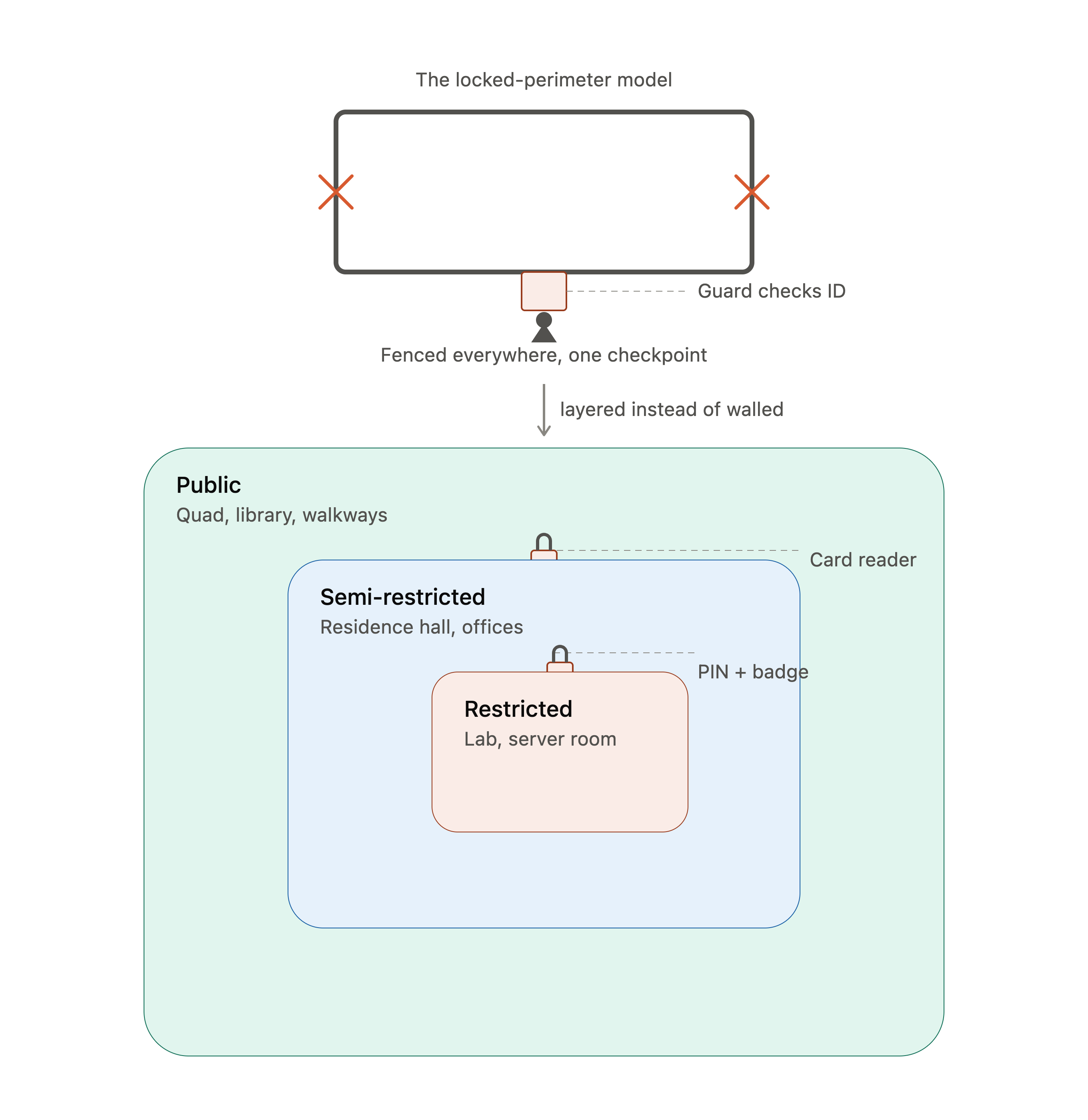
Here is what a locked perimeter looks like on a college campus: a fence, a single entry point, a guard checking ID at the gate, and the end of your mission to be an open institution. For most colleges, that is not a trade they are willing to make, nor should they be. Students thrive because the campus is permeable. The public benefits because the resources are available. The institution grows because the doors are open.
So access control on an open campus has to start with a different question than "how do we keep people out." The real question is "which spaces are actually open, and which ones are not." Because the answer is never "the whole campus is public" or "the whole campus is locked." It is always layered. It is always conditional. It is always based on the actual risk profile of the space in front of you. This is also why perimeter security on a campus looks nothing like perimeter security at a corporate facility. The perimeter is not a wall. It is a series of decisions about which doors carry weight.
A quad with benches and a sculpture garden is public. A residence hall is not. A library study carrel is semi-public; a research lab running a study with restricted data is not. A visitor to campus can be almost anywhere the institution wants them to be, but not everywhere. And the controls that keep a restricted lab secure do not have to feel like a perimeter, because they are not one. They are the handful of doors that actually matter.
This is the resolution to the paradox that keeps coming up in board meetings and parent tours alike: openness and security are not opposing forces on a campus. They are two settings on the same system, and the work is knowing where to set each door. The International Association of Campus Law Enforcement Administrators has built its accreditation standards around exactly this principle: campus safety programs are judged on whether the agency has clear, written policy for what gets controlled and why, not on how many doors are locked.
Layered & Zoned Access
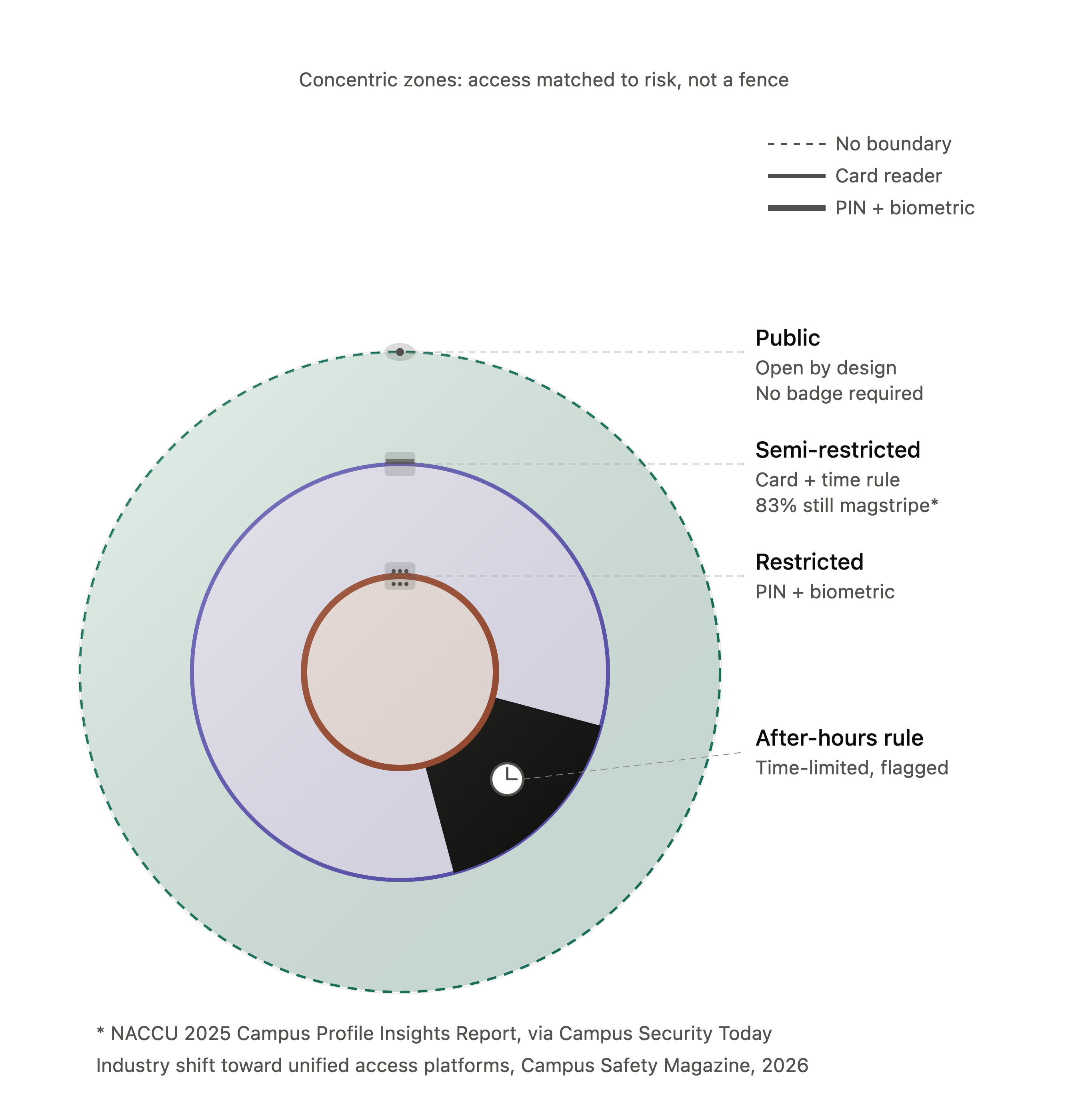
The right way to think about access control is not as a fortress wall. It is as concentric zones, each with its own rules, matched to what actually happens in that space.
Start with the whole campus as the largest circle. Within it, spaces the institution wants genuinely open, quads, lobbies, common areas, the paths between buildings, need no electronic access control at all. They need good lighting (from Part 2), good visibility (from Part 3), and the confidence that a person in that space is supposed to be there, or that someone is watching. The gate here is not a gate. It is design and culture doing the work.
Next come semi-restricted spaces: student housing, faculty offices, certain classroom buildings. These might be open during the day and locked at night. A student ID gets a student into their residence hall on a Tuesday afternoon. The same ID after 11 p.m. still works, because that is home, but a visitor's credential does not. The rule is conditional, and the control is usually a card reader at the front entrance with time-based logic behind it. It is worth knowing what most of those cards actually are: according to NACCU's 2025 Campus Profile Insights Report, as reported by Campus Security Today, 83 percent of schools still rely on legacy magnetic-stripe ID cards, which are inexpensive to duplicate, while only 13 percent have moved to NFC mobile or wearable credentials. A single credential type, especially one that is easy to clone, is exactly why zoning matters more than the card itself. The layer of restriction has to hold even when the credential doesn't.
Then come genuinely restricted spaces: a lab running a federally funded study, a server room, an athletic injury clinic where medical records live, a secure testing facility. These doors carry real access controls, a keycard system, a PIN, sometimes biometric scanning. But these doors exist within an open campus, not instead of one. They are islands of restriction inside a sea of access, not the model for the whole campus.
Finally, there are spaces restricted by exception or time. After-hours access to a building means one person can enter, at that time, for that reason. If that same person shows up at a different building at midnight and their access should have expired, that is a moment worth a camera check and a phone call, not a full campus lockdown.
This is not a fence. It is intelligence applied exactly where the risk lives, and nowhere else. It also matches where the industry itself is headed. A recent Campus Safety Magazine analysis of 2026 security trends found that campuses are moving away from standalone access products toward unified platforms that tie access control, video, and alarms together, precisely so a zoned model like this one can be managed from a single view instead of five disconnected systems.
Campus Doors - Residence Halls, Visitors, Labs
On most campuses, three categories of doors carry disproportionate weight. Getting these three right does most of the work.
Residence halls come first. Students live there. Their safety, privacy, and peace of mind depend entirely on the boundary between who lives there and who does not. That boundary is almost always a card reader, not a fence. A resident's card opens that door for the semester. It does not open other buildings. And the day a student moves out or graduates, the card stops working. That single rule, enforced consistently, protects a residential community without making it feel like one. It is the same principle behind VOLT's work with institutions like Indian Creek School, where a 114-acre campus layered access rules with round-the-clock visibility instead of trying to fence the whole property.
Visitors come second, and they are the group that makes higher ed genuinely different from a corporate campus. A parent, a prospective student, a community member using the library, a vendor delivering equipment, all of these people need to move through campus without a background check at the gate. The answer is not to badge every visitor at every door. The answer is to make the public spaces genuinely public, and reserve verification for the doors that matter. That is the same logic screening platforms like Raptor Technologies apply on the K-12 side, where visitor check-in and watchlist screening happen at specific, defined entry points rather than as a blanket requirement campus-wide. Higher ed's version of that idea is a visitor credential, a sign-in, or an escort requirement applied only where the space actually calls for it, a residence hall, a lab, a restricted facility, not at every door a parent or prospective student might walk through.
Labs and restricted research facilities come third. A lab running a study on sensitive human data does not get security by being gated off from the rest of campus. It gets security by being a space where only people with a legitimate role, researchers, IRB-approved staff, equipment technicians, have access. A grad student from another department does not carry the same card a visitor does. This is not about making campus feel locked down. It is about protecting regulated data and compliant research, and doing it in a way that never touches the openness of the quad two buildings over.
When Campus Access Control Feeds Visibility
This is where the Proactive Campus Safety Stack starts to compound. Access control does not sit by itself. It works with the visibility system from Part 3.
A camera sees someone in the loading dock at 2:30 a.m. That is the visibility layer doing its job. But if the access system for that dock is working, your team already knows who was granted entry, at what time, and for what reason. If the person on camera matches the access log, the alert is contextualized. If they do not match, the alert is validated as a real concern. That combination, a verified visual and a verified credential, is what turns a guess into a fact for whoever has to respond. This is the same logic behind VOLT's virtual security operations center model: a human, not just an algorithm, is the one closing the loop between what a door says and what a camera shows.
The inverse matters too. If an access log shows someone swiped into a building but the camera never shows them leaving, or shows a different person entirely, that mismatch is worth investigating. A card picked up off a desk. A door held open for someone who never swiped. These are the small details that surface a real pattern over time, and neither system catches them alone.
The coordination extends to emergency response as well. VOLT's partnership with CENTEGIX means a verified VOLT detection can feed directly into the CENTEGIX Safety Platform, including CrisisAlert wearable panic buttons. CENTEGIX's 2026 School Safety Trends Report, built from more than 346,000 alerts, found a 31 percent year-over-year increase in panic button activations, and documented a real lockdown at a Georgia school that sealed the building in 37 seconds after activation. A lockdown only works if the doors it depends on are already zoned correctly and the access data behind them is current. Access control is not a separate system from emergency response. It is the mechanism that makes a lockdown actually seal every door that needs sealing, not just the ones someone remembers to check.
The Database Problem
Here is where a lot of institutions stumble. They install the hardware, the readers, the sensors, the locking mechanisms, and treat access control as solved. It is not. Access control is only as good as the database behind it.
A card access system is, underneath everything, a database. A person gets a card when they arrive. They get promoted, change roles, change buildings. They graduate, transfer, or leave the institution entirely. Every one of those moments requires a database entry to update, on time, without exception. A graduation date needs to trigger a card deactivation. A termination needs to revoke access to every door, everywhere, immediately.
This is the unglamorous half of access control, the governance. Neglect it and you have a fortress with the doors quietly unlocked, hardware enforcing rules against data that is years out of date. It is also not optional from a compliance standpoint. The Clery Act requires every covered institution to describe, in its Annual Security Report, exactly how it secures and controls access to campus facilities, including residence halls, as one of the law's mandatory disclosure sections. Getting that description wrong, or having a policy on paper that the access logs don't actually support, carries real exposure: Department of Education fines run up to $71,545 per violation, and the underlying records have to be retained for seven years. A stale access database is not just a security gap. It is a compliance liability with a dollar figure attached.
The institutions that take this seriously treat access control as a living process, not a one-time installation. They run quarterly audits of active credentials. They pull access logs monthly and look for patterns. They test failure modes on purpose: what happens if a graduated student's card is used, what happens if a visitor badge was never deactivated. VOLT's video intelligence platform turns this from a pure data-hygiene exercise into a visibility exercise, flagging unusual access patterns, a person in a building at an hour or in a space they have never used before, for a human to review, so the database audit gets help from behavioral context instead of standing alone. Campuses weighing how to fund that kind of upgrade can also look at available security grant programs built for exactly this kind of infrastructure investment.
The Bottom Line for Open Campus Security
An open campus is not an unsecured campus. It is a campus that has decided which doors matter and which do not, and built the systems to enforce that difference consistently. The doors that are genuinely open stay open. The ones that need to be closed are closed. And the people in restricted spaces are there for a reason the institution understands and can verify, at any hour, on any day.
The work was never adding a fence. It was adding intelligence to the doors that already existed.
Frequently asked questions
Do we really need card access on every building?
No. Most campuses do not, and the ones that manage this well have a clear policy: public spaces stay public, semi-restricted areas like student housing use after-hours card access, and genuinely sensitive spaces like labs, data centers, and medical facilities are the only ones with serious access controls. The goal is friction where it matters and flow everywhere else.
What happens when a student graduates or an employee leaves?
That is the access control governance problem. A resignation or graduation should trigger an immediate card deactivation, ideally automated through your student information system or HR directory. If it is not automated, it becomes a manual audit process run on a set schedule. Either way, the database has to stay current, because a system built on stale data is not a system that works.
Can access control systems talk to our camera systems?
Yes. VOLT can integrate with any system that has an open API, and for proprietary APIs we work with the manufacturer to get the integration working. It also means unusual access patterns, someone in a space at a time they have never accessed it before, can be flagged for human review.
How do visitors fit into a layered access model?
Visitors move freely through the public layer of campus, quads, lobbies, common areas, without needing a credential at all. Verification only applies at the doors that call for it: a residence hall, a lab, a restricted facility. That might mean a sign-in, an escort requirement, or a temporary badge, applied only where the space actually demands it rather than at every entrance on campus.
What if someone tailgates through a restricted door?
Catching it takes access logs and cameras working together. A door registers one swipe but cameras show two people entering. A cardholder is logged as having left a building but cameras show them still inside twenty minutes later. These are the moments access data and video intelligence come together. The system does not need to stop the tailgater in real time. It needs to flag the pattern so a person can investigate and respond.
How do we know if our access control system is actually working?
Run quarterly audits of active credentials. Pull access logs monthly and look for patterns, off-hours access that should not be happening, people entering spaces they have never used before, terminated employees whose cards were never deactivated. Test the failure modes deliberately. Do this regularly and you have a system that works. Skip it and you have a system you are hoping works.
Next in the series: threat assessment and the care team, where the system learns to catch risk early. Previous: Part 1, on treating safety as a program, Part 2, on CPTED and designed spaces, and Part 3, on video intelligence.