Insights


This is Part 3 of "How to Proactively Protect Your Campus," a multipart series. New here? Find parts Part 1 and Part 2 here.
In Part 2, I sent a safety director out to walk his own campus after dark. He came back with a list of blind spots his own eyes had found: the unlit path behind the science building, the stairwell door propped with a brick, the loading dock nobody could see from anywhere. Here is his next assignment, and yours.
Before you fix a single one of those blind spots, go look at what your cameras already saw.
Because when he did, sitting in front of a wall of monitors showing feeds from eight hundred cameras, something uncomfortable landed on him. Almost every blind spot on his list had a lens pointed near it. The cameras had been rolling the whole time. They just were not telling anyone anything.
That is the quiet crisis on most campuses I visit. The problem is never too few cameras. It is cameras that cannot think. Buildings are covered lens to lens, and yet the systems behind those lenses do nothing on their own, so when something happens the first question in the room is still the oldest one in security: can somebody pull the footage? That is not visibility. That is evidence collection after the fact.
Part 3 is about closing that gap without buying a single new camera. It is Layer 2 of the Proactive Campus Safety Stack, Intelligent Visibility, and the whole idea is smaller than most vendors want it to be: make the cameras you already own actually think.
The problem with cameras that only look backward
A recording-only surveillance system is an expensive way to learn you were too late. It captures everything and waits for a person to go searching after an incident. By the time anyone watches the footage, the fight is over, the ambulance has come and gone, and the best you can do is document what happened.
Think about what your team actually does with those feeds today. On a good day, nobody is watching the wall of monitors, because no human can. Watch enough feeds for long enough and attention drifts, and most of what crosses the screen goes unseen. That is not a discipline problem. It is a biology problem. Attention does not scale to a thousand cameras.
So the footage sits there, looking backward, until you need it as evidence. A camera pointed at the right hallway is worthless if the only time anyone looks is the day after. In Part 1 we drew the line between a campus that is highly equipped and one that is actually safe, and this is where that line gets sharp: the entire point of a proactive program is to move the moment of intervention earlier, and a system that only records cannot do that. It can only remember.
Overlay, not rip-and-replace: why your existing estate is the asset
Here is the headline most vendors will not lead with, because it does not sell hardware: you probably don't need new cameras. You need the ones you already own to notice.
Modern video intelligence runs as a software overlay on top of the IP cameras and the video management system you already have. It does not require a forklift upgrade, a new capital project, or a year of installation. Roughly 93 percent of public schools already have cameras in place. The infrastructure is bought and paid for. The thinking layer is the part that is missing.
This matters more in higher education than almost anywhere else, because campus camera estates are enormous, mixed-vintage, and spread across dozens of buildings that were wired in different decades. Ripping all of that out is a multi-year capital fight. Adding a thinking layer on top of it is not. The better overlay platforms need no proprietary hardware and no camera swap; they connect to the equipment a campus already runs and come online in days rather than the months a hardware project takes. In fact, this is exactly how VOLT operates as the intellgence and alert layer on top of your camera infrastructure. The question worth putting in front of your CIO is not which camera to buy next. It is whether the gap is hardware at all, or the layer of intelligence that sits on top of it.
What "thinking" cameras actually catch
"...from cameras that store everything and understand nothing, to cameras that surface the handful of moments a person actually needs to act on."
The best way to understand video intelligence is to stop thinking about predictions and start thinking about patterns. The system learns a building's normal rhythm and flags the deviations from it.
In practice, that means a defined set of conditions that tend to precede or accompany harm: a weapon coming into view, a fight breaking out, a person down and not getting up, someone in a restricted zone at two in the morning, a perimeter crossed after hours, a crowd forming where crowds do not form, theft or vandalism in progress. The systems worth having detect that whole range, not just the rare weapon event, because on most campuses the daily value is the medical emergency, the after-hours door, and the altercation you caught while it was still an argument.
None of this replaces human judgment. It directs human attention. Instead of asking a dispatcher to watch ten thousand hours of footage and somehow spot the two minutes that matter, the system finds those two minutes and hands them over.
That is the shift: from cameras that store everything and understand nothing, to cameras that surface the handful of moments a person actually needs to act on.
The alert-fatigue trap, and why verification is the whole game
Here is where a lot of AI security deployments quietly fail. A campus switches everything on at maximum sensitivity, everywhere, on day one. Within a week the alerts are constant, half of them are shadows and delivery trucks and students cutting through a courtyard, and the team starts ignoring the notifications. The system is not intelligent. It is just loud. You have not removed a blind spot. You have traded it for alert fatigue, which is worse, because now people are trained to swipe the alarm away.
The fix is verification, and it is worth understanding as a design principle rather than a product feature. The strongest deployments put a trained human between the algorithm and the dispatcher. The software finds a candidate moment; a person confirms it in seconds; only a confirmed event reaches the team, with a location attached and, in the better systems, real-time tracking of the subject across cameras. That extra step is the difference between a real program and a noisy one. It is also the honest answer to the worry that AI will bury a small team in noise: done well, the technology augments the people you already have rather than trying to stand in for them, routing the few things that matter to the humans who can act on them. VOLT is built on this superior model, verifying every alert in a staffed operations center before it reaches the customer's team.
The savings tend to follow from that discipline, not from buying more. When the University of Illinois Chicago ran a 30-camera outdoor pilot on its existing cameras, it cut third-party security costs by roughly half, which the campus put at around $236,000 a year for every continuous 24/7 security post the system helped cover. As one campus safety lead described the value of live tracking, "what's the point if you detect something, but I don't know where they went." Detection without location is a headline. Detection, verification, and a dot moving on a map is a response.
Retention, privacy, and student trust as a design choice
If you are a campus leader, the question under all of this is the one your students and your general counsel will ask first: does putting AI on the cameras mean we are surveilling people? It is the right question, and the honest answer is that privacy is not the obstacle to video intelligence. It is a design requirement you build in from the start.
Two decisions carry most of the weight. The first is what the system identifies. Facial recognition is a choice, not a requirement. Some platforms avoid it entirely and work from behavior and movement, gait and patterns, rather than biometric identity, so the system is watching for a fight or a person down without building a record of who walked where. That is the approach worth insisting on for a student community, and it is the one VOLT takes. The second decision is how long you keep footage. Retention should be driven by written policy, not by hard-drive capacity, and for most campuses that lands somewhere between 30 and 90 days for routine footage, with holds applied to anything tied to an incident, an investigation, or a Clery-reportable event. Publish that schedule. It protects the institution twice, as good governance and as a signal to the community that you are not building a permanent archive of student life.
The rest is guardrails you already know how to run: role-based access, video treated as protected data on the level of academic or health records, and independent validation such as SOC 2 certification to point to when someone asks whether you did this responsibly. It all ladders up to one belief this series keeps returning to: openness and security are not enemies. A campus that feels surveilled is not a campus that feels safe, and trust is part of the safety system, not a tax on it. When the privacy and compliance questions higher-ed leaders ask come up, and they will, having these decisions already made is what lets you answer them plainly.
Where this sits in the Stack: visibility feeds every layer above it
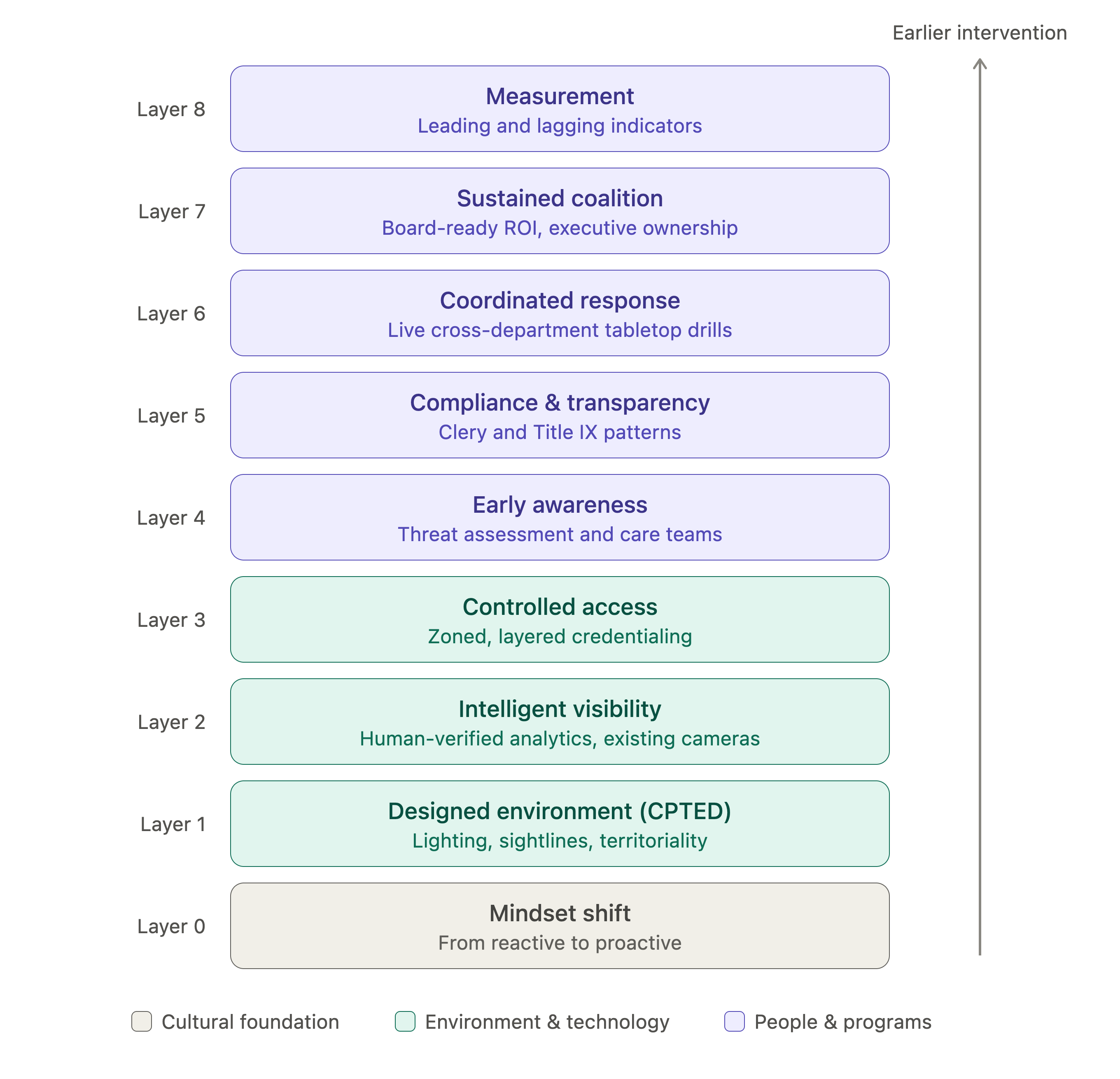
Intelligent Visibility is Layer 2 for a reason. It sits above the designed environment you fixed in Part 2, and everything above it depends on it. Access control is stronger when the system can see a door propped and a tailgater slipping through. Threat assessment is sharper when a real pattern gets flagged instead of buried. Coordinated response is faster when a verified alert arrives already tagged with a location on a 3D map, tracking in real time, with the option of an automatic 911 alert to first responders on a verified threat. Visibility is not a layer that sits by itself. It is the layer that feeds the ones above it.
That is why this comes early in the Stack, and why the fix is not more hardware. The cameras are already watching. The work is teaching them to notice, and making sure that when they do, a real person confirms it before it reaches a real person who has to act.
The bottom line
The least expensive upgrade on campus is the intelligence you add to the cameras you already bought. You do not need a bigger camera count. You need the count you already have to think, to verify before it interrupts anyone, and to respect the people it is watching. Fix that, and the wall of monitors nobody watches becomes a system that watches for you.
Frequently asked questions
Do we have to replace our cameras to add AI?
No. Modern video intelligence runs as a software overlay on the IP cameras and video management system you already own. VOLT requires no proprietary hardware and no camera replacement, connects to existing infrastructure, and is typically operational within days rather than weeks. Given that roughly 93 percent of public schools already have cameras installed, the intelligence layer, not the hardware, is almost always the missing piece.
What is the difference between AI alerts and human-verified alerts?
An AI-only alert fires the moment the software thinks it sees something, which means shadows, delivery trucks, and ordinary foot traffic can all trigger notifications and train your team to ignore them. A human-verified alert adds a step: every VOLT detection is reviewed by a trained operator in the VOLT Security Operations Center before it reaches your team, so the notifications your dispatchers receive are confirmed events, not guesses. That is what prevents alert fatigue and keeps the system trusted.
Does video AI mean facial recognition on students?
Not with VOLT. VOLT does not use facial recognition or biometric identification. It works from behavior and movement, such as gait and activity patterns, to detect events like fights, medical emergencies, and unauthorized access, without identifying individuals by face. Video is treated as protected data, and the platform is designed to comply with state privacy laws.
How long should we retain footage?
Retention should be set by written policy rather than by hard-drive capacity. For most campuses, routine footage is kept somewhere between 30 and 90 days, with longer holds applied to anything tied to an incident, an investigation, or a Clery-reportable event. Publishing that schedule demonstrates good governance and reassures the community that the campus is not building a permanent archive.
Will this create more work for an already-small team?
Usually the opposite. No security operation can staff enough people to truly watch a thousand cameras, which is the exact problem intelligence solves. Instead of assigning officers to screen-watching, verified alerts route to the people you already have, dispatch, patrol, and facilities, each with a location and live tracking. VOLT is a force multiplier, not a replacement for staff, so the same team covers more ground without a proportional increase in headcount.
Next in the series: coordinated response, where a verified alert becomes a rehearsed action. Previous: Part 1, on treating safety as a program rather than a purchase, and Part 2, on the night walkthrough that surfaced these blind spots in the first place.