Insights


In Part 1, I left a safety director standing on the quad on a Tuesday afternoon, surrounded by six new cameras, unable to tell his board whether the campus was any safer than last year. Here is his next assignment, and yours. Walk that same quad again. This time at 10 PM.
Your campus at 10 PM is a different campus than it is at 2 PM. The shadows sit in different places. Half the lights you assumed were working are out. The shortcut students actually take between the residence hall and the north parking lot turns out to have nobody watching it. None of that is visible from an office window in daylight, which is exactly why most campus assessments miss the things that matter most.
Here is the part that should get a budget committee's attention: the physical campus itself is already either working for you or working against you, before you buy a single new camera. Shaping it to work for you is the cheapest security investment available, and it has a name that has been around for decades. CPTED, or Crime Prevention Through Environmental Design. In the Proactive Campus Safety Stack I laid out in Part 1, this is Layer 1, the designed environment. It sits that low in the stack on purpose. Everything you add above it works better when the ground floor is solid, and fights you when it is not.
Two rules that make a walkthrough actually work
If you cannot answer a question about your own campus after dark, you have just learned where your next blind spot is.
Before the four principles, two ground rules. Ignore either one and the exercise turns into a formality that changes nothing.
Do it after dark. Most campus assessments happen in daylight, on a calm weekday, which is precisely why they miss what matters. Threats do not keep office hours. Walk the campus at 10 PM, when the lighting gaps are real, the buildings are half-empty, and the routes people take are the ones that feel safe rather than the ones on the map.
Bring facilities with you. This is the rule that saves money. Roughly half of what you find on a night walk is not a security purchase at all. It is a burned-out fixture, an overgrown hedge, a door that closes but does not latch. If the person who can write the work order is standing next to you, the finding becomes a fix instead of a memo. That is the whole promise of CPTED: your environment is the first and cheapest line of defense you have.
One more thing to carry with you. Every "I don't know" is a finding. If you cannot answer a question about your own campus after dark, you have just learned where your next blind spot is.
The four principles, and the ten questions behind them
CPTED rests on four principles. The walkthrough below maps ten questions directly onto them. Answer each one honestly, on foot, at night.
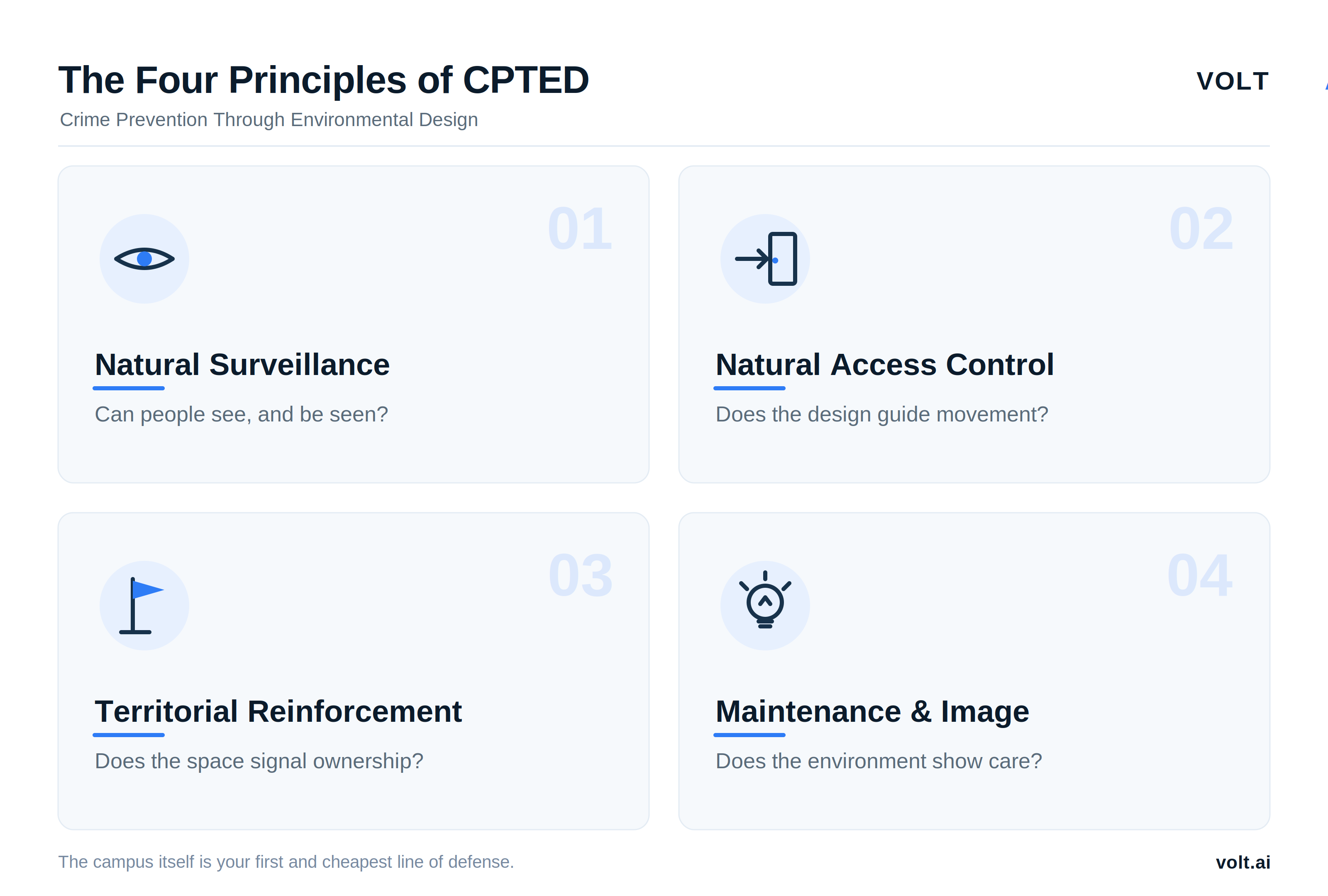
Natural surveillance: can people see, and be seen? This is the oldest idea in the discipline, and the research behind it is consistent. Offenders avoid places where they can be observed and identified. Your job on the walk is to find the spots where that breaks down.
- Standing at your busiest quad after dark, can you clearly make out a face at 30 feet, or only a silhouette?
- Which walking routes between residence halls and parking have zero natural eyes on the path after 9 PM?
- Where has landscaping grown tall enough to conceal a person, whether that is hedges, low tree canopies, or blind corners?
Natural access control: does the design guide movement? Good design tells people where they are supposed to go without a single sign, and makes the wrong path feel wrong. When that fails, people improvise, and improvised access is the access you cannot see.
- Can a visitor tell where public campus ends and restricted space begins, without reading a sign?
- How many doors that should be locked are propped, taped, or "temporarily" disabled right now? Every propped door is a control someone on your campus quietly voted against.
Territorial reinforcement: does the space signal ownership? People treat cared-for, clearly-owned space differently than anonymous space. Ambiguous territory invites intrusion. Owned territory deters it.
- Do your building entrances communicate "someone is responsible for this space," or "nobody is watching"?
- Are the boundaries between spaces defined by design, through paving changes, lighting shifts, or low walls, or are they left ambiguous?
Maintenance and image: does the environment show care? Neglect compounds. A broken window that stays broken tells everyone who passes that no one is paying attention, and that message travels. This is also where the cheapest fixes usually hide.
- How many lights are burned out on your three most-traveled nighttime routes? If you do not know, that is the answer.
- What is the average time between a broken light or door being reported and being repaired?
- And the one I always end on: if a parent walked your campus at 10 PM tonight, what would the environment tell them about how much you care?
Where to point the walk: quads, parking, residence halls, labs
You cannot walk everything in one night, so start where the principles are most likely to fail.
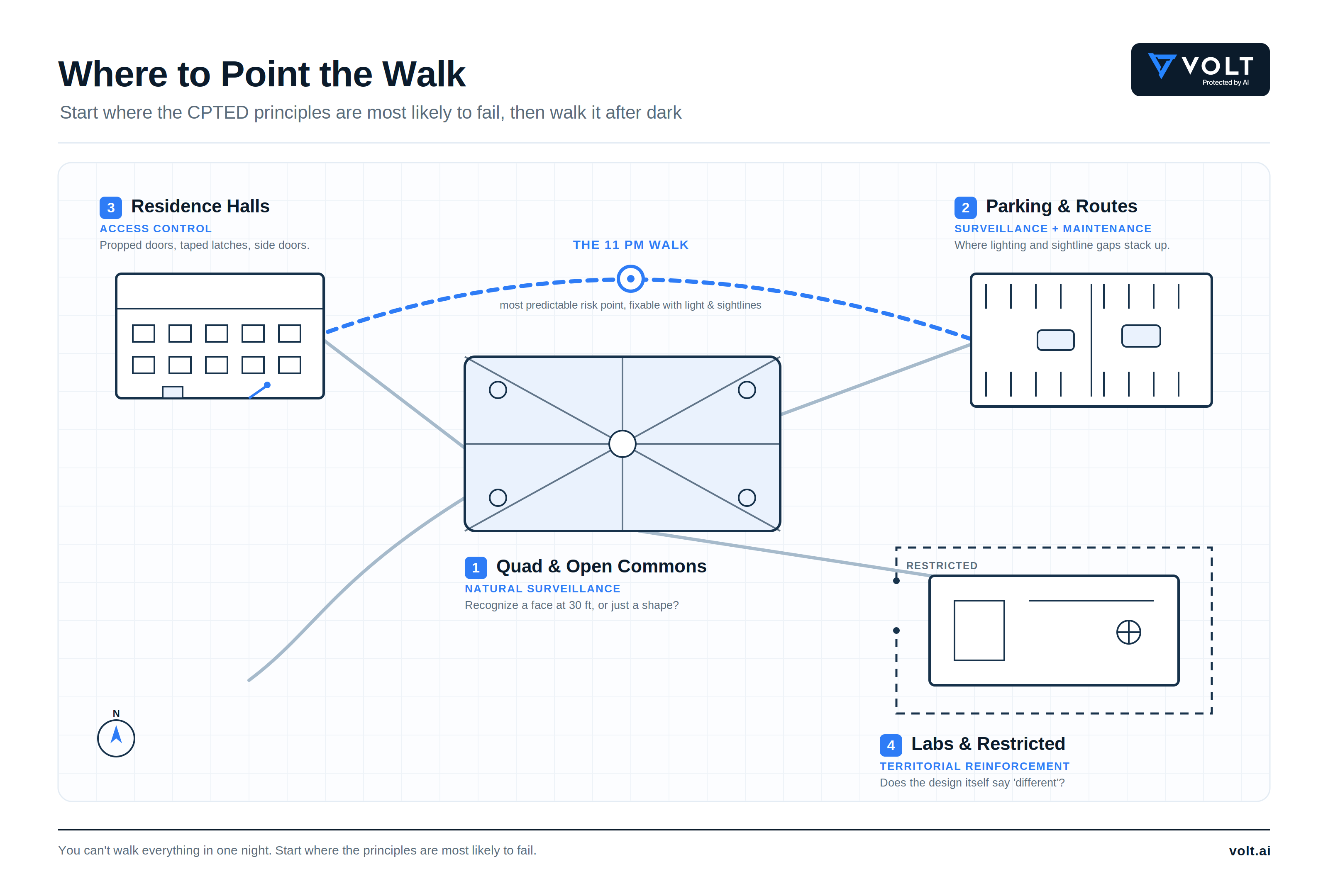
Quads and open commons are natural-surveillance tests. They look safe at noon because they are full of people. After dark, check whether the lighting actually lets you recognize a face, or just register a shape.
Parking areas and the routes to them are where surveillance and maintenance problems stack up. The walk between a residence hall and a lot at 11 PM is one of the most predictable risk points on any campus, and one of the most fixable with light and sightlines.
Residence halls are access-control tests. This is where you will find the propped doors, the taped latches, and the side entrances that everyone uses and no one manages.
Labs and restricted facilities are territorial-reinforcement tests. The question is whether the design itself makes clear that this space is different, or whether it depends entirely on a sign and an honor system.
Where the environment ends and technology begins
Here is the honest limit of CPTED. It shrinks the number of opportunities. It does not eliminate them, and it cannot watch the campus for you at 3 AM. A perfectly designed quad still needs someone to notice when something goes wrong on it, and no safety team is large enough to keep eyes on every route, every hour.
That is the handoff from Layer 1 to Layer 2 of the stack. Once the environment is doing everything it can, the remaining gaps are exactly where intelligent visibility earns its place. VOLT layers onto the cameras you already own and adds human-verified monitoring through a Virtual Security Operations Center, so a real operator confirms an event before it ever reaches your team. It does not replace the walkthrough, and it does not replace your officers. It covers the hours and the corners that people physically cannot, which is the definition of a force multiplier. Fix the environment first. Then make sure something is watching the parts the environment cannot fix. If perimeter routes and after-hours coverage are where your walk turns up the most gaps, VOLT's perimeter security approach is built for exactly that layer.
Take the field sheet and walk your campus this week
Everything above fits on one page. I turned the ten questions into a printable CPTED night walkthrough field sheet so you can carry it, score yourself honestly, and hand facilities a punch list the next morning. Print it, bring a colleague from facilities, and walk your busiest nighttime routes this week. Do not wait for a budget cycle. Most of the first round of fixes will not cost you anything but attention.
The bottom line
The most expensive security problem is the one you never walked out to see. Before the next line item, before the next platform, spend one night on foot with someone who can write a work order. Your campus will tell you almost everything you need to know, if you are willing to look at it after dark and answer honestly. The environment is the first line of defense, it is the cheapest, and it is already there. Use it.
Download the CPTED night walkthrough field sheet and walk your campus this week. Then, when you are ready to cover the gaps the environment cannot, see how VOLT works with the cameras you already own.
Frequently Asked Questions (FAQ)
What is CPTED?
CPTED stands for Crime Prevention Through Environmental Design. It is the practice of shaping the physical environment, through lighting, sight lines, landscaping, access points, and clear boundaries, so that a space naturally discourages incidents before any technology or staffing is added. It rests on four principles: natural surveillance, natural access control, territorial reinforcement, and maintenance and image.
Why should a campus security assessment be done at night?
Because a campus at 10 PM is a fundamentally different environment than the same campus at 2 PM. Lighting gaps, shadowed routes, and blind corners only reveal themselves after dark, and threats do not keep daytime hours. Most assessments are done in daylight, which is exactly why they miss the conditions that matter most. A night walkthrough shows you the campus your community actually experiences after hours.
Who should take part in a CPTED walkthrough?
At minimum, someone from security or public safety and someone from facilities, walking together. Roughly half of what a walkthrough surfaces is a maintenance issue, not a security purchase, so having the person who can write the work order on the walk turns findings into fixes immediately instead of weeks later.
Does CPTED replace security cameras or technology?
No. CPTED is the first layer, not the whole program. It reduces the number of opportunities for an incident, but it cannot monitor a campus around the clock or notice when something goes wrong on a well-designed quad at 3 AM. Environmental design and technology work together: you fix what the environment can fix, then use tools like human-verified video intelligence to cover the hours and blind spots people cannot.
How often should we do a night walkthrough?
Treat it as a recurring habit, not a one-time audit. A walk at the start of each semester catches seasonal changes in daylight, foliage, and student traffic patterns, and a quick re-walk after any major construction, landscaping, or lighting change keeps new blind spots from going unnoticed. The point is that the environment changes continuously, so the assessment should too.
About Demetrius Anderson
Demetrius Anderson spent 38 years as a police officer and first responder protecting some of the nation's most sensitive environments, from Biosafety Level 3 laboratories and Cesium-137 research facilities to formal liaison roles with the Illinois State Terrorism and Intelligence Center, Chicago's counter-terrorism center (CPIC), and the Department of Homeland Security. At the University of Illinois Chicago, he helped architect a first-of-its-kind real-time visual intelligence solution that analyzed live surveillance feeds, detected anomalies, and triggered automated responses, all on the university's existing camera infrastructure. That experience shaped the philosophy that defines his work today: prevention doesn't come from more cameras, it comes from making the cameras you already have smarter.