Insights


In this new series from VOLT, 38-year police officer and first responder, Demetrius Anderson, will cut through the noise around campus safety, access control, technology, CPTED, and response plans for universities across the country.
"Safety is a program, not a purchase."
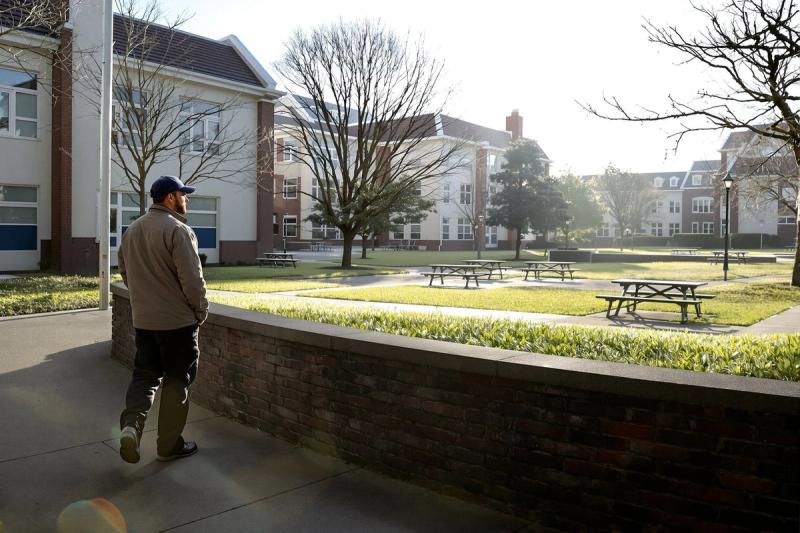
Picture a campus safety director walking the quad on a Tuesday afternoon in October, past six brand-new cameras his team fought the budget committee for all spring. He still can't answer the one question his board keeps asking.
Are we actually safer than we were last year?
That question is the whole problem. Most higher ed institutions try to answer it by pointing at equipment, because equipment is the thing you can see, budget for, and install. But a camera is a record, not a result. It tells you what already happened. It does not tell you whether you prevented anything.
Cameras don't make a campus safe. Programs do.
The Reactive-Tool Trap
When a security gap surfaces, a break-in, a near-miss, a state audit finding, the fastest thing an administrator can do is buy something. A camera. A card reader. A monitoring contract. It feels like progress, and it is easy to defend in a budget meeting.
The problem is what happens next. Each purchase gets made in isolation, so each one becomes its own island: separate licensing, separate support contract, separate login for a different team. That is how campuses end up drowning in cameras while starving for insight. Nobody set out to build a fragmented system. It accreted, one reasonable purchase at a time. And every one of those standalone systems is really just a record of what the campus failed to prevent.
Calling that collection of tools a strategy does not make it one. Cameras don't make a campus safe. Programs do.
What a security incident actually costs
Here is the math that reframes the whole conversation: the fallout from a single security failure is almost always larger than the cost of preventing it.
Take a data breach where an attacker compromises a campus server. That one event can force a university to notify tens of thousands of students, staff, and alumni, absorb months of IT time, invite regulatory scrutiny, and do reputational damage that outlasts the technical fix by years. Disjointed systems quietly raise that risk, because every extra platform is one more attack surface, one more renewal to track, one more thing that can fail unnoticed.
Prevention rarely shows up as a line item, which is exactly why it gets undervalued. The incident that never happens never generates a cost. But it is almost always the cheapest option on the table. If you want to see where your own numbers land, VOLT's cost-benefit calculator walks through the math for your specific camera count and budget.
Proactive investment can also pay back directly. When the University of Illinois Chicago piloted AI-powered monitoring across 30 outdoor cameras, the school cut third-party security costs by roughly 50%, about $236,000 a year for every 24/7 position it no longer needed to staff. That is not a projected efficiency. It is a budget line that went on to fund other priorities, and it is one of several real customer stories worth reading if you are building the case internally
What a real campus safety program looks like
A real campus safety program is welcoming by design, not a fortress. It rests on three things working together, none of which you can buy off a shelf.
A culture of safety, not surveillance. The best sensor on any campus is a person who knows what to report and trusts that reporting it will matter. That culture erodes the moment people feel watched rather than protected, which is why the surveillance question is not an ethics footnote, it is an adoption problem. VOLT was built with that in mind. It uses behavioral and gait-based analysis, not facial recognition or any form of biometric ID, so a campus can add real-time awareness without turning every student into a face in a database. Treat Clery Act and Title IX reporting as more than annual paperwork, too. The patterns inside those reports are early warnings, if anyone is reading them as such.
Cross-functional coalitions. No single office owns safety. It takes an active partnership between Public Safety, Student Affairs, Facilities and Operations, IT, and Executive Leadership, each with a real stake in the outcome rather than just a seat at the table. Technology does not replace that coalition. It gives the coalition better information to act on. As Noah Skinner, Director of Safety and Emergency Management at UC Law San Francisco, puts it:
"Even with the best security staff, human limitations exist... [good technology] ensures that critical activity is detected and immediately brought to our attention."
That is the force-multiplier idea in one sentence. The people stay in charge. The system makes sure nothing critical slips past a tired eye at 3 a.m.
An aligned, strategic roadmap. Instead of buying point solutions as gaps appear, proactive campuses start by mapping their current state, defining clear functional requirements, and tying the safety plan to institutional goals, including the goal of staying open and welcoming rather than locked down. If you are weighing cost, procurement, or implementation timelines, VOLT's Higher Education FAQs cover the questions campus leaders ask most.
The Proactive Campus Safety Stack
Shifting the moment of intervention earlier means moving up a stack, not just buying up a shopping list. Nine layers, building on each other:
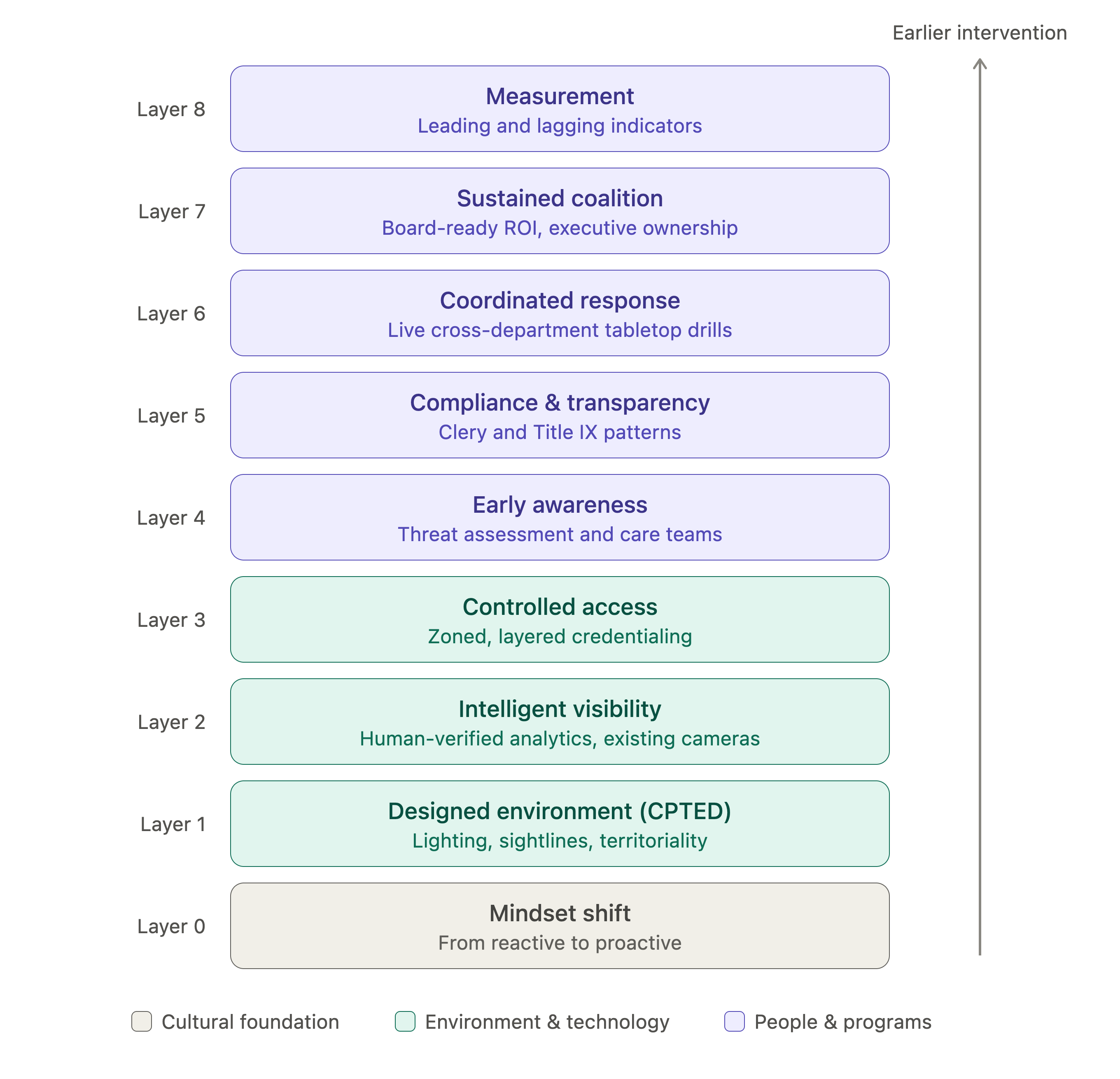
- Layer 0 — Mindset Shift: moving the entire campus culture from reactive response to proactive prevention.
- Layer 1 — Designed Environment (CPTED): using lighting, sightlines, landscaping, and territoriality so the physical campus itself deters incidents.
- Layer 2 — Intelligent Visibility: layering smart video analytics — including a human-verified Virtual Security Operations Center — onto the cameras you already own, instead of a costly rip-and-replace project.
- Layer 3 — Controlled Access: layered, zoned credentialing that balances open, welcoming spaces with real security in critical areas.
- Layer 4 — Early Awareness: threat assessment and care teams that route concerns to help before they become incidents.
- Layer 5 — Compliance & Transparency: turning Clery and Title IX reporting into a proactive engine that surfaces patterns of risk.
- Layer 6 — Coordinated Response: moving emergency preparedness out of a binder and into live, cross-department tabletop drills.
- Layer 7 — Sustained Coalition: building a board-ready ROI case that secures long-term funding and shared executive ownership.
- Layer 8 — Measurement: defining leading and lagging indicators that prove prevention is actually working, so the program keeps improving.
The bottom line
A camera is not a strategy. A card reader is not a strategy. Even the best individual tool, bought in isolation, just becomes one more thing your team has to log into. Real campus safety is a program: a culture that reports, a coalition that owns the outcome together, and a roadmap that ties it all to what your institution is actually trying to be. Build the program, and the tools finally start earning their keep.
Request a demo and see how VOLT's school security solutions can turn your existing cameras into more than a record of what already happened — before your next Tuesday afternoon walk across the quad.
Frequently Asked Questions (FAQ)
What is the difference between campus security tools and a campus safety program?
Security tools like cameras, access control, and monitoring software are components. A campus safety program is the strategy that connects them to a reporting culture, a cross-functional coalition, and a roadmap tied to institutional goals. The simplest test is this: if you removed any single tool, would your safety strategy still make sense? In a program it does, because the strategy drives the tools. In a tool pile it does not, because the tools were the strategy.
Do we have to replace our existing cameras to build a proactive program?
No, and replacing them is usually the wrong move. Modern AI video intelligence, including VOLT, layers onto the IP cameras and video management system you already own, so the value comes from making existing infrastructure smarter rather than from a rip-and-replace project. Most deployments are operational within days, not months.
How is a proactive program different from just adding AI to our cameras?
AI on its own can flag more events, but more alerts without verification just creates a new problem: alert fatigue. VOLT routes every potential incident to a human operator in its Security Operations Center for verification before it ever reaches your team, so what lands in front of your staff is a confirmed event with a map location, not another notification to second-guess. The program is what decides who acts on that verified alert, and how.
What is CPTED, and why does it matter for a college campus?
CPTED, or Crime Prevention Through Environmental Design, uses lighting, sightlines, landscaping, and clear territoriality to make a physical space naturally discourage incidents. On a campus it means designing security into renovation and construction plans from the start, rather than retrofitting it after something goes wrong. It sits at Layer 1 of the stack because the cheapest incident to manage is the one the environment quietly prevents.
Who actually needs to be involved in a cross-functional safety coalition?
At minimum: Public Safety, Student Affairs, Facilities and Operations, IT, and Executive Leadership. Leave one of those groups out and the program tends to develop a blind spot exactly where that group's expertise was needed. The coalition is also what keeps a safety program funded across budget cycles, because shared ownership is much harder to cut than a line item owned by a single department.
About Demetrius Anderson
Demetrius Anderson spent 38 years as a police officer and first responder protecting some of the nation's most sensitive environments — from Biosafety Level 3 laboratories and Cesium-137 research facilities to formal liaison roles with the Illinois State Terrorism & Intelligence Center, Chicago's counter-terrorism center (CPIC), and the Department of Homeland Security. At the University of Illinois Chicago, he helped architect a first-of-its-kind real-time visual intelligence solution that analyzed live surveillance feeds, detected anomalies, and triggered automated responses — all on the university's existing camera infrastructure. That experience shaped the philosophy that defines his work today: prevention doesn't come from more cameras, it comes from making the cameras you already have smarter.