Insights
School Arrival and Dismissal Procedures: A Practical Safety Guide
Arrival and dismissal are the two busiest parts of a school day. Within about twenty minutes, hundreds of students, buses, family cars, walkers and bikes all converge on the same few doors and curbs. Doors that stay locked the rest of the day are open. Adults who don't work at the school are on campus. And staff are spread thin across the building.
Good arrival and dismissal procedures make those twenty minutes predictable. This guide covers what a written plan should include, how to lay out the bus loop and car line, where to post staff, and how to handle the moments that go off script.
Why arrival and dismissal need their own plan
The CISA K-12 School Security Guide names arrival and dismissal as critical times. It recommends keeping a single entry point or a small number of them, having staff present at those entry points while students come and go, and keeping every other exterior door closed outside those windows. The same guide suggests posting hallway monitors at arrival, dismissal and passing times.
Traffic safety is the other half. The Seattle Department of Transportation's arrival and departure toolkit for school safety committees puts it simply: separate the modes of travel. Buses, cars, walkers and young bike riders each need their own clearly defined approach. U-turns and backing up are among the least safe things a driver can do at a busy curb.
What a written arrival and dismissal plan should include
Many districts publish a formal procedure. Prince George's County Public Schools Administrative Procedure 5090 is a useful public model. Whatever format you use, the plan should answer these questions:
- Which doors open, and when. List the doors used at arrival and at dismissal, and the time each one locks again.
- The release order. Decide whether walkers, bus riders or car riders leave first, or whether you stagger the bells. Staggering keeps the groups from crossing paths.
- Staff posts. Name every post (front door, bus loop, car line, crosswalk, holding area) and who covers it, including a backup.
- Escort rules. Say which students are walked out by an adult. Pre-K through grade 2, and students who need extra support, are common examples in district procedures.
- Pickup authorization. Set out how staff confirm that an adult is on the approved pickup list, and what happens if they aren't.
- Late pickups. Say where students wait, who stays with them, and when families are contacted.
- Emergencies at dismissal. Describe how shelter-in-place, lockdown or evacuation changes the routine, and how families will be told.
Review the plan every year. Enrollment, construction and staffing all change how the curb works.
How to lay out the bus loop and car line
Bus loop safety
Keep private cars out of the bus loop completely while buses are loading. Many district handouts put this rule in capital letters for good reason. Mark the loop with cones or gates, post staff at the entry, and walk younger riders to their bus. The NHTSA school bus safety page notes that children are most at risk when they are getting on or off a bus. It advises staying at least ten feet, or five giant steps, from the bus, never walking behind it, and waiting until the driver says it's okay to board.
Car rider line procedures
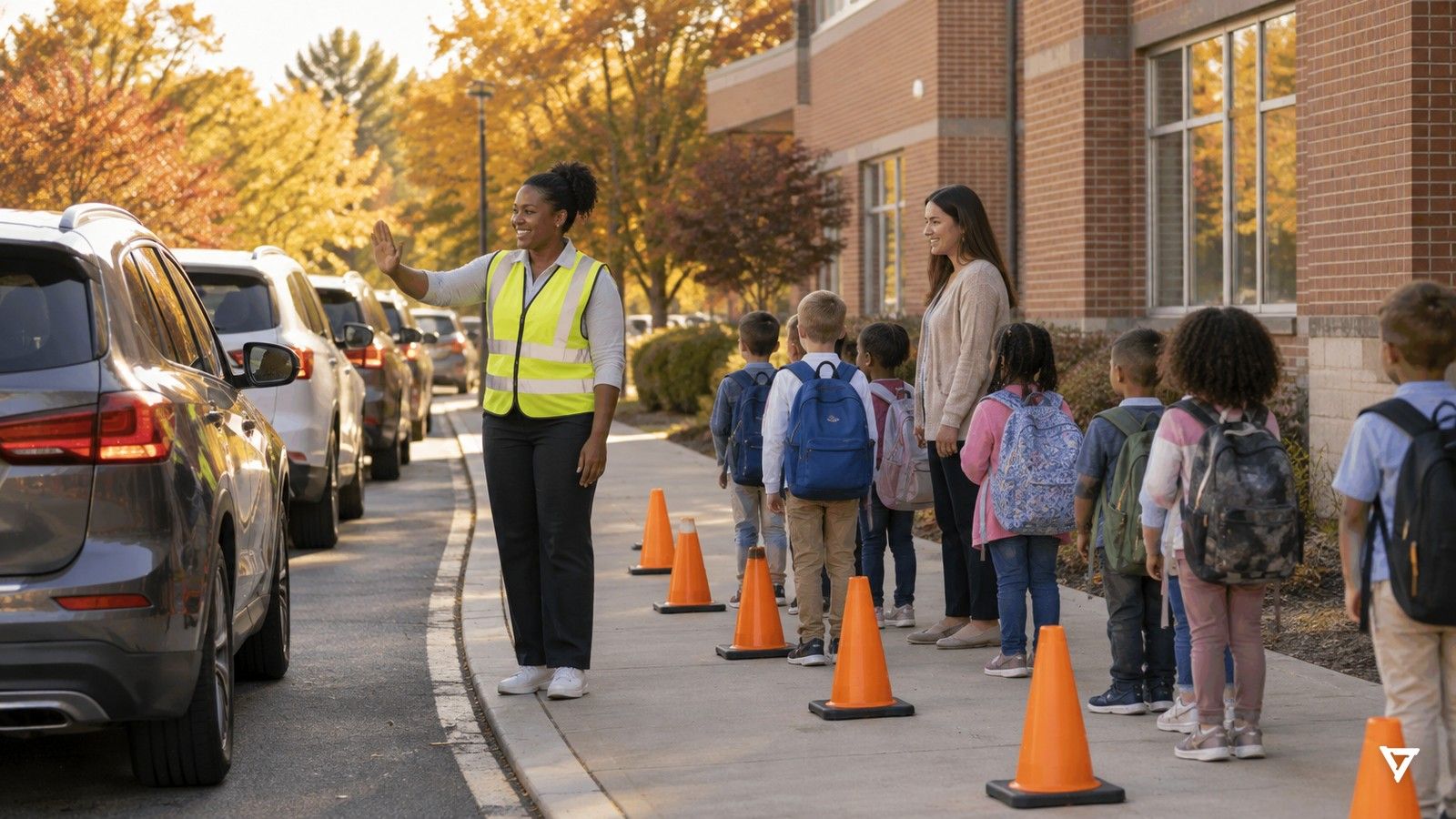
- Run the line one way and single file, with a clear entry and exit. Don't let cars pass, double-park or stop in the bus lane.
- Drivers stay in their cars. Staff or student patrols open the doors, and students get in and out on the curb side.
- Use visible name cards on dashboards so staff can call students forward before each car reaches the loading zone.
- Keep walkers out of the parking lot. Students on foot should never have to cross a drive aisle to reach the sidewalk.
Walkers and bikes
Publish suggested walking routes that cross the fewest streets and use marked crossings, and match them to the door where walkers are dismissed. Minnesota Safe Routes to School's mapping guide shows how to turn the plan into a one-page map families can actually use.
Where to post staff at arrival and dismissal
Staff are the most important part of any dismissal plan. A practical posting map usually includes:
- The main entrance, where one adult greets students and notices anyone who doesn't belong.
- The bus loop entry and the far end of the bus line.
- The head of the car line, plus one adult at the loading zone.
- The crosswalks nearest the school, often covered by crossing guards.
- Indoor holding areas and the hallway leading out to each exit.
- A floater. This is usually an administrator who can move to whatever goes off script.
Give every post a radio or a shared channel. Keep the posts the same from day to day so families learn who to look for.
Handling the moments that go off script
Most dismissals are routine. The plan earns its keep on the days that aren't:
- An adult who isn't on the pickup list. Keep the student inside with staff, contact the family on file, and never release a student under pressure at the curb.
- A student who doesn't show up at the bus or the car line. Have a set first step: check the classroom, then the holding area, then any after-school program. Then widen the search.
- A side door propped open for a late delivery or a friend. Assign one person to sweep the exterior doors once dismissal ends.
- A disagreement near the buses. Send the nearest adult early, while it's still small, and keep the bus line moving.
- Weather or an early release. Keep a shorter version of the plan ready, and send it to families through several channels.
Communicating the plan to families
A plan only works if families follow it. The Seattle toolkit recommends sending every message through at least five channels: the handbook, a printed flyer, email, the school website and messages from teachers. Include a simple map. Send it again after winter break, when routines slip, and whenever a construction project or a new bell schedule changes the curb.
Where camera coverage fits
Cameras don't replace adults at the curb, but they can help a small team keep track of a large, busy area. VOLT is built to notice moments: a fall, a fight, someone where they shouldn't be. VOLT tracks a person by visual appearance across the camera footprint and shows that track on a 3D floor plan, so first responders reach where the situation is unfolding now, not where it started. VOLT detects handguns, long guns, and knives that are visible to the camera. VOLT is designed to work with most IP cameras you already have. Some older analog cameras may need an upgrade. By default, a VOLT reviewer checks it before your team is notified.
At dismissal, that might mean seeing that a student slipped on the bus-loop curb, or that an adult walked in through a side door while staff were outside.
Related reading: Access control and open campus security · CPTED for modern school campuses · After-hours school security
Frequently asked questions
How long should school dismissal take?
There's no national standard. Times vary by school; staggering the release can shorten it. If the line regularly runs long, look at the layout and the release order before adding more staff.
Who should be allowed to pick up a student?
Only adults on the student's authorized pickup list. That list should be kept current through enrollment forms, with ID checked when staff don't know the adult. Custody orders on file should be flagged to front-office staff.
Should cars ever be allowed in the bus loop?
Not while buses are loading or unloading. Most district procedures ban private vehicles from bus lanes during arrival and dismissal so that students never have to walk between buses and moving cars.
How often should arrival and dismissal procedures be reviewed?
At least once a year, ideally with a short observation of a real dismissal, plus whenever enrollment, construction or bell times change. Our K-12 school security self-assessment includes these routines in its review.
Helping schools and campuses look out for the moments that matter.