Insights


Security cameras schools deploy should deliver measurable safety improvements, not just surveillance footage. While 91% of public schools now use security cameras, most measure success using outdated metrics that fail to capture actual safety outcomes. Forward-thinking institutions focus on detection speed, response time reduction, incident prevention rates, and cost per protected student rather than camera counts or square footage monitored.
What Makes Security Cameras Schools Use Effective?
School administrators face mounting pressure to justify security investments. District leaders scrutinize budgets. Parents demand accountability. Yet most schools measure security success using outdated metrics that fail to capture actual safety improvements.
The typical approach counts cameras installed, security personnel hired, or square footage monitored. These numbers look impressive in budget presentations. They fail to answer the question that matters most: Are students and staff actually safer?
Modern security cameras schools implement should serve as proactive protection tools rather than passive recording devices. The shift from traditional surveillance to intelligent video analytics represents a fundamental change in how educational institutions approach campus safety.
Why Traditional Security Camera Metrics Fall Short
Traditional security budgeting treats cameras and personnel as independent line items. Schools count cameras deployed across campus. They calculate coverage percentages based on square footage. They measure security presence by the number of officers on staff.
These metrics create an illusion of comprehensive security. Research shows that traditional security approaches monitor less than 5% of cameras in real time. Human operators cannot watch dozens of feeds simultaneously. By the time someone reviews footage, the opportunity for intervention has passed.
The cost structure compounds this problem. Schools spend an average of $46.87 per student annually on school resource officers who provide limited coverage during school hours. A typical high school with 1,500 students invests over $70,000 yearly in physical security personnel. That investment provides limited coverage during school hours and no monitoring after dismissal.
How Should Schools Measure Security Camera ROI?
Security cameras schools install should deliver measurable safety improvements, not just surveillance footage for post-incident investigations. Forward-thinking schools now evaluate their investments using four outcome-based metrics that directly correlate with student and staff safety.
Detection Speed: From Minutes to Seconds
Traditional security operations depend on someone noticing an incident and reporting it. Each scenario involves delays that can prove critical. Why software-based security solutions outperform hardware-only approaches in long-term effectiveness becomes clear when examining detection speed improvements through AI-powered video intelligence that eliminates these delays by monitoring 100% of cameras 100% of the time.
The University of Illinois Chicago demonstrated this transformation across their 250-acre urban campus. Their security team manages 30,000 students across 3,500 cameras. Before implementing intelligent video analytics, their monitoring capabilities matched industry standards at less than 5% real-time coverage.
AI-powered detection across 142 critical camera streams changed their response paradigm. Medical emergencies that previously went unnoticed for minutes now trigger alerts within 15 seconds. A man who collapsed in an elevator lobby received help 90% faster than traditional security approaches would have allowed.
This represents how intelligent video analytics deliver benefits beyond basic surveillance coverage that security cameras schools can leverage. Continuous automated monitoring catches threats the moment they emerge, creating critical windows for intervention that traditional systems miss entirely.
Response Time Reduction: Measuring What Happens After Detection
Detection speed matters only if it enables faster response. The gap between identifying a threat and neutralizing it represents the window where incidents escalate.
Prescott High School in Arizona transformed their security approach by focusing on response time rather than coverage area. The school serves approximately 1,400 students across a typical high school campus. They implemented technology that turned those cameras into an active response system.
When a student suffered an asthma attack in an empty hallway, the system detected the medical emergency and alerted staff within 15 seconds. The school nurse reached the student before the situation became critical. Fight detection capabilities demonstrate similar response improvements, with staff now intervening within seconds of aggressive behavior beginning.
Modern security cameras in high schools enable rapid threat response through AI-powered detection that schools deploy should enable this type of capability. Every second saved in the detection-to-response cycle increases the likelihood of preventing serious harm.

Incident Prevention Rate: Measuring Threats That Never Materialize
The most effective security measures prevent incidents rather than respond to them. Traditional metrics cannot capture incidents that never occur because deterrence worked. UIC's implementation of comprehensive threat detection provides quantifiable prevention metrics.
The system detects suspicious activity around bike racks, scooter parking, and other high-risk areas in real time. Security personnel receive immediate notification when someone spends unusual amounts of time near vulnerable equipment.
Occupancy monitoring during off-hours replaced expensive third-party security contracts. The system alerts when unauthorized individuals enter buildings after designated hours. This capability eliminated the need for overnight guard services while providing more comprehensive coverage.
Security cameras schools use for prevention deliver ROI that extends far beyond incident response. By stopping problems before they escalate, these systems reduce both direct costs (theft, vandalism) and indirect costs (staff time, insurance claims).

Cost Per Protected Student: The True Value Calculation
Security investments should demonstrate clear cost efficiency when measured against the population they protect. Traditional security approaches create high per-student costs. School resource officers represent the largest security expense at an average of $46.87 per student annually.
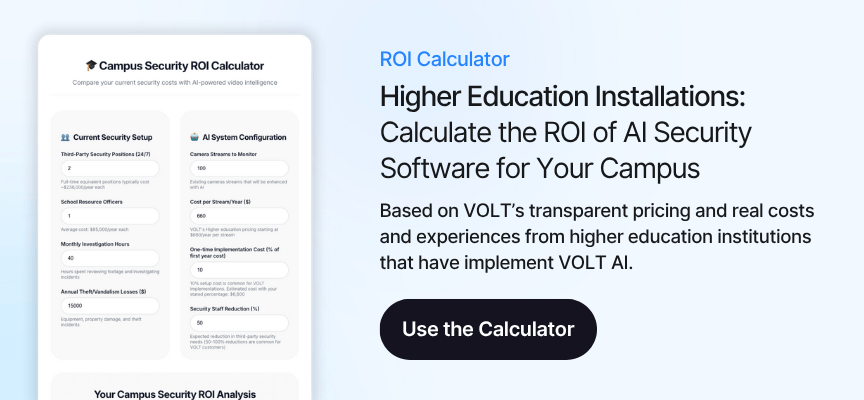
Adding 24/7 security coverage through traditional staffing compounds these costs dramatically. UIC calculated that round-the-clock security positions cost approximately $236,000 annually at $27 per hour.
AI-powered video intelligence transforms this cost structure. Systems integrate with existing camera infrastructure, eliminating major hardware replacement expenses. The technology monitors all cameras simultaneously, providing coverage that would require dozens of human operators.
UIC reduced their third-party security contractor expenses by roughly half after implementation. For higher education institutions seeking comprehensive AI-powered protection strategies that deliver measurable cost savings, the cost savings from eliminating contracted guard services, combined with theft and vandalism prevention, created positive ROI within the first year.
Security cameras schools invest in should deliver measurable per-student cost reductions while improving safety outcomes. This dual benefit makes AI-powered video intelligence one of the most cost-effective security investments available to educational institutions.
Comparing Traditional vs. Outcome-Based Security Metrics
Security administrators need clear frameworks for evaluating their current approach against outcome-based alternatives. This comparison table breaks down how traditional metrics differ from measurements that directly correlate with safety improvements.
|
Metric Category |
Traditional Measurement |
Outcome-Based Measurement |
Impact on Safety |
|
Coverage |
Number of cameras deployed |
Percentage of cameras actively monitored 24/7 |
Traditional approach monitors less than 5% of cameras in real time; outcome-based achieves 100% coverage |
|
Response |
Number of security staff |
Average time from incident detection to staff intervention |
Traditional response measured in minutes; AI-powered systems achieve 15-second alert times |
|
Prevention |
Security hardware specifications |
Incident reduction rates by category |
Traditional focuses on capability; outcome-based measures actual prevention (e.g., 75% theft reduction) |
|
Cost Efficiency |
Total security budget |
Cost per protected student with measurable outcomes |
Traditional averages $46.87/student for limited coverage; comprehensive AI monitoring reduces per-student costs significantly |
|
Detection |
Camera resolution and field of view |
Speed from incident start to threat identification |
Traditional relies on manual observation; AI detection occurs within seconds of incident beginning |
This framework shift reveals why many schools invest heavily in security yet struggle to demonstrate improved safety outcomes. Traditional metrics measure inputs and capabilities. Outcome-based metrics measure the results those capabilities produce.
What Are the Implementation Considerations for Outcome-Based Security?
Transitioning from traditional security metrics to outcome-based measurement requires systematic planning and clear success criteria. Schools can implement this shift without replacing existing infrastructure or disrupting current operations.
The first step involves assessing current security cameras schools already have installed and identifying monitoring gaps. Understanding whether to integrate AI software with existing cameras or replace entire security systems proves critical, as AI-powered video intelligence integrates with existing cameras, transforming passive recording systems into active detection platforms. Robinson Independent School District in Texas completed their system integration in less than two weeks.
Staff training requirements prove minimal compared to traditional security system implementations. The technology operates autonomously, requiring no manual monitoring or complex configuration. Security teams receive alerts on mobile devices when the system detects priority events.
Modern video analytics platforms work with existing IP cameras, eliminating the need for complete system replacements. Schools can begin with pilot programs covering high-priority areas, then expand coverage as they document measurable improvements in detection speed and response times.

Visit the full resource center.
Which Key Performance Indicators Matter Most?
Effective security programs require quantifiable KPIs that demonstrate progress toward safety goals. These metrics should be tracked monthly and reported quarterly to stakeholders.
- Detection Speed KPI: Measure average time from incident start to first alert. Target should be alert delivery within 15 seconds for priority events. This metric directly correlates with response effectiveness.
- Response Time KPI: Calculate average time from alert notification to staff arrival at incident location. Compare response times for different incident types to identify areas requiring operational improvements.
- Incident Prevention KPI: Track incidents by category monthly and compare against historical baselines. Calculate percentage reductions for theft, unauthorized access, medical emergencies, and conflicts. UIC's 75% theft reduction provides a benchmark.
- Coverage Efficiency KPI: Measure the percentage of campus areas with active threat monitoring versus passive recording. Traditional security operations achieve less than 5% active monitoring. AI-powered systems should demonstrate 100% active coverage.
- Cost Efficiency KPI: Calculate total security costs divided by student population served. Track this metric quarterly and compare against per-student costs for traditional security staffing.
Security cameras schools deploy should enable measurement across all these KPIs. Systems that cannot provide this data leave administrators unable to demonstrate safety improvements or justify budget allocations.
How Can Schools Build a Measurement Framework?
Security administrators can begin implementing outcome-based metrics immediately using their current systems as baselines. Start by documenting current state metrics for one semester. Record response times for different incident types. Count incidents by category. Calculate total security costs including personnel, contractors, and technology expenses.
Identify priority outcomes based on your school's specific security challenges. Schools with high theft rates should prioritize incident prevention metrics. Campuses concerned about medical emergencies should focus on detection speed and response time. Urban schools managing large populations might emphasize cost efficiency per protected student.
Select technology solutions based on their ability to deliver measurable improvements in your priority areas. Request demonstrations that show actual detection capabilities rather than technical specifications. Robinson ISD's two-week implementation timeline demonstrates that comprehensive deployment need not be a multi-year project.
Report metrics in formats that resonate with different stakeholders. School boards need cost efficiency data and safety outcome improvements. Parents want to understand how detection capabilities protect their children. Staff members require evidence that new systems improve their ability to respond effectively.
What Impact Does Outcome-Based Security Have Beyond ROI?
Outcome-based security metrics do more than justify budgets. They transform how schools approach safety planning and create cultures of proactive protection rather than reactive response.
AI-powered video intelligence shifts the paradigm from reactive to proactive. Every camera becomes an active participant in threat detection. The system operates continuously without fatigue or distraction. Security teams receive specific, actionable alerts that enable immediate intervention.
Principal Adam Neely at Prescott High School described the shift: "This is the first time where I really have been able to be out ahead of things that are happening. I'm not just using my cameras for investigation, I'm using them for immediate action and response."
Students and parents notice the difference. Response times measure in seconds rather than minutes. Theft attempts get interrupted before completion. Medical emergencies receive immediate attention. The visible evidence of improved safety creates confidence in the school's ability to protect its community.
Security cameras schools implement with AI-powered intelligence create safer environments while demonstrating measurable ROI. This combination addresses both the practical need for budget justification and the fundamental mission of protecting students and staff. For administrators seeking comprehensive strategies to safeguard educational environments in the modern era, understanding outcome-based metrics provides the foundation for effective security planning.
Frequently Asked Questions About Security Cameras Schools Use
How much do security cameras for schools typically cost?
Security camera costs vary based on system complexity, but the total cost of ownership should be measured against outcomes rather than initial investment. Traditional systems focusing on hardware costs miss the bigger picture. AI-powered video intelligence integrates with existing cameras, minimizing hardware expenses while dramatically improving detection capabilities. Schools should calculate cost per protected student, factoring in reduced theft, eliminated security contractor expenses, and faster emergency response. UIC reduced contractor costs by roughly half while achieving 75% theft reduction, demonstrating positive ROI within the first year.
What percentage of schools use security cameras?
According to the National Center for Education Statistics, 91% of public schools reported using security cameras in 2019-2020. However, deployment alone doesn't guarantee effective security.
Traditional approaches monitor less than 5% of cameras in real time, meaning most schools have extensive camera infrastructure but limited active monitoring capability. Current infrastructure assessments of security cameras in public schools across the United States reveal that the critical question isn't whether schools have cameras, but whether those cameras enable proactive threat detection and rapid response.
Do security cameras actually prevent incidents in schools?
Research demonstrates that security cameras significantly prevent incidents when integrated with AI-powered detection capabilities. Prescott High School now intervenes in conflicts within seconds rather than minutes.
Traditional passive recording provides limited prevention value, as deterrence requires active monitoring and rapid response. Modern AI-powered systems detect suspicious activity, extended dwell times, and unauthorized access in real time, enabling intervention before incidents escalate.
How long should schools retain security camera footage?
Retention requirements vary by state, with most schools maintaining footage for 30-90 days. Texas mandates six-month retention for certain recordings. Schools must balance storage costs against investigation needs and compliance requirements.
Modern cloud-based systems with intelligent compression reduce storage costs while maintaining required retention periods. More important than retention duration is the ability to quickly search and retrieve relevant footage. AI-powered systems enable keyword-based searches and automated clip generation, dramatically reducing investigation time.

Can AI-powered security cameras integrate with existing school cameras?
Yes, modern AI-powered video intelligence platforms integrate with existing IP cameras, eliminating the need for complete system replacement. Robinson Independent School District completed their system integration in less than two weeks. The technology works with virtually any IP camera manufacturer, processing video feeds through cloud-based or on-premise analytics engines.
This compatibility allows schools to enhance their current security infrastructure rather than starting from scratch, significantly reducing implementation costs and time. Understanding AI-powered school security systems and their deployment process helps administrators plan successful implementations.
What types of threats can AI-powered school security cameras detect?
AI-powered video intelligence detects a comprehensive range of threats including weapons, unauthorized access, medical emergencies, fights and aggressive behavior, theft and vandalism, extended dwell times in sensitive areas, and occupancy during off-hours. The technology continuously learns and improves detection accuracy.
Unlike traditional motion detection that generates frequent false alarms, advanced AI systems understand context and distinguish between normal activity and genuine threats. This precision ensures security teams respond to actual incidents rather than wasting time on false positives. For schools prioritizing advanced technologies that prevent the most critical security threats, comprehensive detection capabilities provide peace of mind while delivering measurable safety improvements.
Partner with VOLT for Outcome-Based Security
Transitioning from traditional security metrics to outcome-based measurement requires technology that delivers measurable improvements. VOLT transforms existing security cameras schools have already installed into comprehensive threat detection systems that monitor 100% of cameras 100% of the time.
Our AI-powered video intelligence integrates with your current camera infrastructure. Schools typically complete deployment in less than two weeks and begin seeing measurable improvements immediately.
Detection capabilities span the full spectrum of school safety concerns. Medical emergency detection identifies students or staff in distress within seconds. Fight detection enables intervention before conflicts escalate. Weapon detection provides critical early warning for the most serious threats.
Cost per protected student drops significantly compared to traditional security staffing approaches.
Schedule a demo to see how VOLT can help your school measure what actually matters.