Security Cameras for Schools: The Complete Guide to Protection That Works
Security Cameras for Schools: The Complete Guide to Protection That Works
What's in the Guide?
- Understanding the security camera decision: Traditional hardware-centric approaches focus on physical equipment purchases and deployment, while intelligence-first systems transform existing cameras into proactive safety tools through AI-powered software.
- The intelligence gap costs more than money: Passive camera systems require constant human monitoring to be effective, creating staffing challenges and response delays that can mean the difference between prevention and reaction during critical incidents.
- Software-first solutions reduce total cost of ownership: AI-powered systems like VOLT work with existing camera infrastructure, eliminating expensive hardware replacement cycles while providing comprehensive threat detection for less than the cost of a single full-time security officer.
- Modern threats demand comprehensive detection: Schools need security systems that go beyond weapon detection to identify medical emergencies, fights, unauthorized access, and behavioral concerns across their entire campus in real time.
- Implementation speed creates immediate value: Advanced AI security software can be deployed in days rather than months, transforming hundreds of existing cameras without disrupting school operations or requiring extensive IT infrastructure changes.
Don't have time to read this?
Take a copy with you
- 1 Rethinking School Security: Beyond Cameras and Hardware
- 2 The Hardware-First Trap: Coverage Without Intelligence
- 3 The Intelligence Gap: Why Passive Systems Fail Schools
- 4 The Total Cost of Hardware-First Security
- 5 The Software-First Paradigm: Intelligence Over Infrastructure
- 6 VOLT's Comprehensive Intelligence Platform
- 7 Making the Right Decision for Your School
- 8 Creating Safer Schools Through Intelligent Security
- 9 Frequently Asked Questions About Security Cameras for Schools
- 10 Download Now
- 1 Rethinking School Security: Beyond Cameras and Hardware
- 2 The Hardware-First Trap: Coverage Without Intelligence
- 3 The Intelligence Gap: Why Passive Systems Fail Schools
- 4 The Total Cost of Hardware-First Security
- 5 The Software-First Paradigm: Intelligence Over Infrastructure
- 6 VOLT's Comprehensive Intelligence Platform
- 7 Making the Right Decision for Your School
- 8 Creating Safer Schools Through Intelligent Security
- 9 Frequently Asked Questions About Security Cameras for Schools
- 10 Download Now
Table of Contents
Select Your Chapter
School security has reached an inflection point. Administrators across the country face a troubling reality: they have invested heavily in security cameras for schools, access control systems, and physical barriers, yet they still struggle to prevent incidents and respond quickly when problems arise.
The issue is not a lack of cameras. Most schools already have them. The issue is that most school camera systems only record, so nobody notices a moment until it is reviewed later.
For decades, the school security industry has operated under a hardware-first paradigm. Schools purchase cameras, install them throughout their campuses, and assume that visibility equals security. This approach has created a false sense of protection while leaving critical gaps in actual safety capabilities.
The fundamental question facing school administrators today is not "how many cameras do we need?" but rather "how do we make our security cameras for schools intelligent enough to protect our students proactively?" This shift from hardware quantity to software intelligence represents the most significant evolution in school security since the introduction of video surveillance itself.
The fundamental weakness of hardware-first security becomes clear when examining real-world incident response. Passive surveillance systems create what security professionals call "the intelligence gap," the distance between when an incident begins and when humans become aware of it and can respond effectively.
School surveillance systems without AI capabilities operate on a simple premise: record everything and hope someone notices when something goes wrong. This approach fundamentally fails the primary purpose of school security, which is protecting students and staff through proactive intervention.
The Human Monitoring Challenge
Schools attempting to solve the monitoring problem through staffing face prohibitive costs. Achieving truly comprehensive human monitoring would require one security professional for every 8 cameras, working in shifts to provide 24/7 coverage. For a school with 80 cameras, this translates to 30 full-time employees dedicated solely to camera monitoring.
The cognitive demands of video monitoring exacerbate this challenge. Security personnel must maintain constant attention while filtering out normal activity to identify potential threats. This task requires sustained concentration that human psychology cannot maintain indefinitely. Attention drift begins within the first half hour, and fatigue compounds throughout longer shifts.
Response Time Realities
The intelligence gap directly impacts the most critical security metric: response time. Response sequences for passive camera systems typically follow this pattern: incident begins, minutes pass with no detection, someone eventually notices or reports the situation, security reviews camera feeds to locate the incident, and responders are dispatched with actionable information.
This sequence can take 5 to 15 minutes from incident start to informed response. Every second matters in critical situations like medical emergencies, fights escalating to violence, or weapon-related threats. Security cameras in schools must do more than record; they must actively detect and alert.
The Forensic Value Trap
Passive security systems excel at one task: providing evidence after incidents occur. However, forensic capability alone represents a fundamental failure of security philosophy. Security's primary purpose should be prevention and rapid intervention, not documentation.
A camera that captures crystal-clear footage of a student collapsing from a medical emergency has failed in its core mission if no one saw the incident in time to provide immediate assistance. A system that records a fight in perfect detail but did not alert staff until the situation escalated has not truly protected students. School security camera systems must transition from passive recording to active protection. Students and staff need protection in real time, not well-documented evidence of threats that were not prevented.

Financial analysis reveals that hardware-centric approaches carry far higher costs than initial price tags suggest. A typical medium-sized high school with 1,500 students deploying 100 cameras might invest $200,000 to $400,000 initially for equipment, installation, infrastructure upgrades, and video management systems. Funding becomes harder to obtain at higher levels.
Staffing Costs Dwarf Equipment Expenses
The most significant cost in traditional security programs is not hardware but the human resources required to operate it. Security Resource Officers (SROs) represent the most common staffing approach. Schools spend an average of $46.87 per student annually on SRO resources, or approximately $70,000 per year for a 1,500-student high school.
Third-party security contractors typically cost $25 to $35 per hour per security officer. A single 24/7 security position costs approximately $236,000 annually at $27 per hour. Many schools employ hybrid approaches with SROs during school hours and contracted security for after-hours coverage.
None of these approaches solve the fundamental intelligence gap problem. Security cameras for schools need intelligent software to bridge the gap between passive recording and active protection.
Five-Year Reality Check
A realistic five-year cost analysis for a 1,500-student high school implementing hardware-centric security:
Year 1 (Initial Deployment):
- 100 IP cameras with installation: $160,000
- Network infrastructure upgrades: $50,000
- VMS software and storage server: $30,000
- Security staffing (2 SROs plus after-hours coverage): $190,000
- Total Year 1: $430,000
Years 2 to 5 (Annual Ongoing Costs):
- Security staffing: $190,000 per year
- Storage expansion: $8,000 per year
- Equipment maintenance and repairs: $12,000 per year
- Software updates and licensing: $5,000 per year
- Annual Ongoing: $215,000
- Four-Year Total: $860,000
Five-Year Program Total: $1,290,000
This analysis excludes incident costs, opportunity costs of staff time on reactive activities, and inevitable camera upgrades before five years. The true cost likely exceeds $1.5 million for moderately comprehensive hardware-centric security.
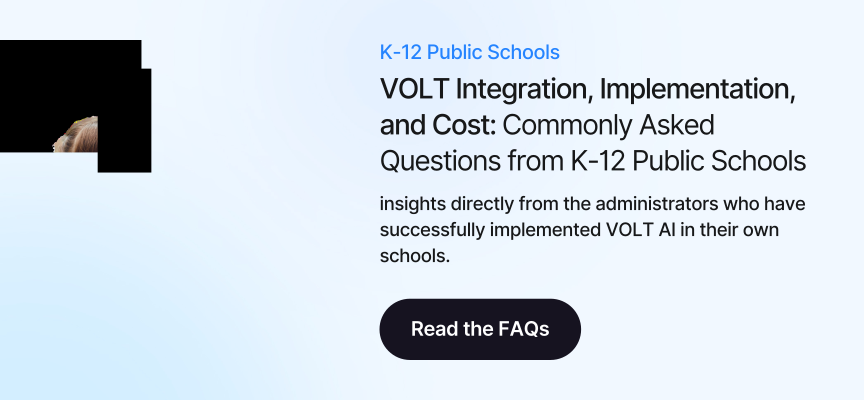
Try it: the school camera cost calculator — estimate in about two minutes whether adding AI to your existing cameras costs less than replacing them.
A fundamental reimagining of school security has emerged. Rather than accumulating hardware and hoping humans can effectively monitor it, the software-first approach adds intelligence directly to existing camera infrastructure. This paradigm shift recognizes that security is fundamentally an information problem, not an equipment problem.
AI-powered video surveillance for schools transforms how security cameras operate. Instead of passive recording devices, cameras become active monitoring systems capable of detecting threats, emergencies, and concerning behaviors in real time.
From Passive Recording to Active Intelligence
Software-first security transforms cameras from passive recording devices into active monitoring systems capable of understanding what they see. VOLT is built to notice moments: a fall, a fight, someone where they shouldn't be.
This transformation happens without replacing cameras or infrastructure. Schools that have already invested in IP camera deployments preserve those investments while adding the intelligence layer. The cameras continue capturing video, but now sophisticated AI software analyzes that video in real time to identify situations requiring human attention.
The shift eliminates the impossible task of asking security personnel to watch dozens of screens simultaneously. AI handles continuous monitoring while humans focus on response and decision-making. This division of labor creates security capabilities greater than either could achieve alone. School surveillance systems become proactive rather than reactive.
Comprehensive Safety Monitoring Beyond Weapons
While weapon detection captures headlines, comprehensive AI security systems monitor for a much broader range of safety concerns that deliver daily value rather than serving primarily as insurance against rare catastrophic events.
Person-down alerts let staff know when someone has fallen or appears to be in distress. At Prescott High School, VOLT noticed a student having an asthma attack in an empty hallway and alerted staff, who reached her quickly.
Fight and altercation detection catches physical conflicts as they develop, allowing intervention before situations escalate. Early intervention prevents injuries, reduces disciplinary consequences, and maintains a safer school climate. The University of Illinois Chicago reported that VOLT helped them notice fights as they started, enabling staff to separate students before confrontations became serious.
Unauthorized access monitoring helps ensure restricted areas remain secure. VOLT can create custom rules for specific locations, alerting when someone enters equipment storage areas after hours or accesses restricted zones without authorization.

Real-World Transformation Examples
Schools implementing software-first security have documented dramatic improvements in safety capabilities and operational efficiency. Robinson ISD in Texas deployed VOLT and achieved implementation in just 2 to 3 weeks from decision to live system. The IT department reported that VOLT was the easiest software integration they had ever experienced.
Robinson ISD particularly valued VOLT's ability to work with their existing "hodgepodge of cameras" purchased at different times with different specifications. Security Director David noted that the system transformed their security operations from reactive to proactive, allowing them to address situations before they escalated. Their school CCTV cameras became intelligent monitoring tools rather than passive recorders.
Prescott High School in Arizona implemented VOLT and immediately began benefiting from comprehensive threat detection. The system has noticed a student in distress in an empty hallway, identified fights at onset, monitored for weapons and unauthorized access, and provided security staff with real-time awareness across the entire campus. Principal Adam Neely highlighted how VOLT allowed the school to be "out ahead of things that are happening" rather than constantly reacting after the fact.

Cost Comparison: Software vs. Hardware
The financial advantage of software-first security becomes clear when comparing it to traditional approaches. Aspen Academy found that implementing VOLT cost less than hiring a single full-time security employee.
CFO Lynda Sailor noted: "Hiring the equivalent of one full-time security employee to attempt to do even a fraction of what VOLT can costs more than the VOLT system. When you think of it that way, it is a massive cost savings." The school also avoided insurance rate increases that other schools experienced, with rates remaining flat after VOLT implementation.
The University of Illinois Chicago realized substantial savings by reducing their reliance on third-party security contractors after implementing VOLT across 142 cameras. The system's ability to provide comprehensive monitoring allowed UIC to cut third-party security needs significantly while achieving better security outcomes.
*costs are estimates based on industry averages

School administrators face critical decisions about security investments that will impact their communities for years to come. A framework for evaluating security options can help ensure decisions align with actual safety needs. Choosing between hardware expansion and intelligent software requires understanding the fundamental differences in approach.
Evaluating Security Camera Systems: Hardware vs. Intelligence
The central decision facing schools is not whether to invest in security but rather where to invest resources for maximum effectiveness. Consider these contrasts when evaluating security cameras for schools:
Hardware-First Limitations:
- Requires continuous human monitoring to be effective
- Provides primarily forensic value after incidents
- Demands substantial ongoing staffing costs
- Creates upgrade treadmill as technology evolves
- Scales poorly as camera counts increase
Intelligence-First Advantages:
- Provides automated continuous monitoring across all cameras
- Delivers proactive detection before incidents escalate
- Reduces staffing requirements while improving outcomes
- Software updates enhance capabilities without hardware replacement
- Scales efficiently as camera counts increase
The evidence strongly favors intelligence-first approaches for schools that already have basic camera infrastructure. Adding AI analysis to existing cameras delivers greater security improvements per dollar invested than adding more unmonitored cameras or maintaining large security staffing levels. School surveillance systems need intelligence to fulfill their protective purpose.
Understanding Total Cost of Ownership
Financial decisions should account for multi-year costs rather than focusing exclusively on initial investment. Create a five-year cost projection including equipment purchase and installation, ongoing staffing requirements, maintenance and replacement cycles, storage infrastructure, and opportunity costs of inadequate security.
Compare this projection against software-first alternatives that leverage existing camera investments while adding comprehensive threat detection.
Building Stakeholder Support
Successful security initiatives require support from multiple constituencies including school boards, parents, teachers, and students. Software-first security offers compelling benefits for each group.
School boards appreciate the cost-effectiveness and clear ROI that software-first approaches deliver. Parents value comprehensive safety that addresses daily concerns like medical emergencies and bullying, not just catastrophic threats. Teachers need security that does not disrupt education or create prison-like atmospheres. Students benefit from faster emergency response and proactive intervention that prevents situations from escalating.
Security cameras for schools work best when all stakeholders understand their purpose and capabilities. Transparent communication about what AI-powered systems can and cannot do builds trust and cooperation.
Implementation Realities
Most VOLT implementations go live in two to three weeks from decision, because there is no new hardware to install.
VOLT uses a per-camera-stream pricing model with transparent costs available on the company website. This straightforward pricing eliminates hidden fees and allows schools to accurately budget for security software. The per-camera cost is substantially lower than the annual cost of security personnel. School CCTV cameras become intelligent monitoring tools for a fraction of staffing expenses.
What are the most important features to look for in school security cameras?
The most important feature in modern school security cameras is AI-powered intelligence that can actively detect threats rather than just recording footage. Essential capabilities include real-time threat detection (weapons, medical emergencies, fights), clear alerts that tell security teams where to go, integration with existing camera infrastructure to preserve investments, multi-threat monitoring that goes beyond weapon detection, and privacy-conscious architecture that protects sensitive areas.
Traditional features like high resolution and night vision remain important, but without intelligent software analyzing footage in real time, even the best hardware serves primarily as a forensic tool rather than a protective system.
Can AI security cameras detect weapons and medical emergencies at the same time?
Yes, advanced AI security systems monitor for multiple threat types simultaneously across all camera feeds. VOLT's multi-threat detection identifies weapons (firearms, knives, other dangerous objects), medical emergencies (falls, seizures, signs of distress), physical altercations and fights, and unauthorized access to restricted areas.
The AI processes video from all cameras continuously, applying different detection models simultaneously without performance degradation. This comprehensive monitoring provides daily value beyond weapon detection alone, catching medical crises, behavioral incidents, and security concerns that occur far more frequently than weapon-related threats.
How quickly can schools implement AI-powered security camera software?
Most VOLT implementations go live in two to three weeks from decision, because there is no new hardware to install. Setup includes a camera inventory, configuring existing cameras, location-specific alert rules, team training and integration with your response plan.
Schools can implement AI security at the beginning of a semester or even mid-year without disrupting operations. The software works with existing IP cameras, eliminating the installation delays associated with hardware procurement and physical deployment.
Do AI security cameras comply with student privacy laws and regulations?
Modern AI security systems like VOLT are designed specifically to comply with student privacy regulations including FERPA (Family Educational Rights and Privacy Act). VOLT's privacy-conscious architecture does not use facial recognition technology, eliminating concerns about identity tracking. The system monitors behaviors, objects, and situations rather than identifying specific individuals.
Schools can configure privacy zones that completely block monitoring in sensitive areas like bathrooms, counseling offices, and locker rooms while maintaining security coverage in common areas. All footage is encrypted, access is permission-based and logged, and video is only stored as needed for security purposes. Schools should review their specific state and local regulations, but AI systems can be configured to meet compliance requirements while still providing comprehensive threat detection.
What happens when an AI security camera detects a potential threat?
When VOLT notices a potential moment, by default a VOLT reviewer at the Security Operations Center checks the alert before your team is notified, filtering out harmless moments. Reviewed alerts then go to the staff in your escalation plan with a location on the 3D floor plan.
Your school chooses how each type of moment is routed. Custom escalation plans send falls, fights and other moments to the right staff without overwhelming them.
Can AI security cameras work with our existing school security camera system?
Yes, AI-powered security software like VOLT is specifically designed to work with existing school security cameras and infrastructure. The system is camera-agnostic, meaning it integrates with virtually any IP camera brand and model already deployed on campus, including mixed installations with cameras purchased at different times from different manufacturers. VOLT adds the intelligent analysis layer without requiring hardware replacement, preserving previous security investments while dramatically enhancing capabilities.
The software works with existing network infrastructure and requires minimal additional bandwidth. Schools with "hodgepodge" camera systems, as described by Robinson ISD, can implement AI security without replacing a single camera, turning their existing passive recording devices into intelligent threat detection systems.
How accurate are AI security cameras at detecting weapons in schools?
AI weapon detection has improved significantly, and human review of alerts helps filter out false positives.
By default, a VOLT reviewer at the Security Operations Center checks weapon alerts before school staff are notified, which cuts alert noise.
The combination of AI detection and human verification provides accuracy rates that traditional security measures cannot match.
What is the difference between passive and intelligent school security cameras?
Passive school security cameras record video footage continuously but require human operators to review footage and identify threats, which typically happens after incidents have already occurred. These cameras serve primarily as forensic tools, providing evidence after the fact. Security staff cannot effectively monitor more than 6 to 9 camera feeds simultaneously, leaving most of the campus unobserved at any given moment. Intelligent security cameras use AI software to actively analyze video in real time, detecting weapons, medical emergencies, fights, and unauthorized access as they occur.
The AI monitors all cameras simultaneously and immediately alerts security personnel only when intervention is needed. Intelligent cameras shift security from reactive documentation to proactive prevention, enabling intervention during incidents rather than investigation after incidents. The fundamental difference is that passive cameras record while intelligent cameras protect.
How do school security camera systems help during active emergency situations?
AI-powered school security camera systems dramatically improve emergency response capabilities in several critical ways. During active emergencies, the system provides real-time location tracking that follows threats throughout the facility across multiple camera views, eliminating the need to manually search feeds. Security personnel and first responders receive immediate visual confirmation of threats, precise 3D location information, and continuous updates as situations develop.
The system's 3D facility mapping gives responders clear situational awareness of threat locations, safe zones, and optimal response routes. Automated alert escalation ensures appropriate personnel are notified based on threat type and severity.
These capabilities give school staff clear, located alerts so they know where to go.

Further reading
See VOLT on your own cameras.
A short call, your sites, and a clear view of what VOLT would notice.
No commitment · Runs on the cameras you already have