Insights


Why Schools Consider Upgrading Lorex Cameras
Budget season arrives, and the same conversation happens in administrative offices across the country. Security footage looks grainy. Cameras seem outdated. The natural instinct is to replace hardware.
Lorex cameras have served schools reliably for years. They offer affordability, wide availability, and familiarity for IT teams. When administrators feel their security system falls short of addressing modern threats, the assumption often points to newer cameras with higher resolution or better night vision.
This assumption misses the fundamental issue. The cameras work fine. The monitoring capability is the weakness.
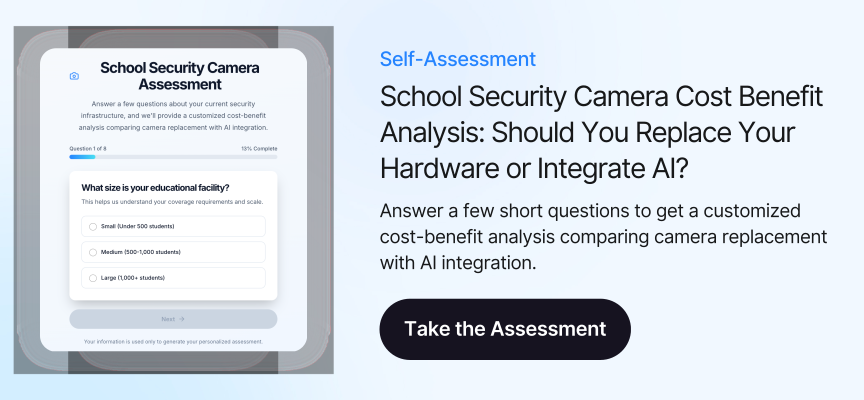
Take our School Security Camera Assessment.
The Real Problem with School Security Camera Systems
Consider what happens with most school camera systems today. Footage streams continuously from dozens or hundreds of Lorex cameras and other equipment across campus. That footage records to a server somewhere. Then it sits unwatched until something goes wrong.
When an incident occurs, administrators pull footage after the fact. They scrub through hours of video trying to piece together events. The cameras captured everything, but no one was watching in real time.
This is not a resolution problem. A 4K camera recording an empty hallway does not prevent a fight from escalating. A brand-new Lorex system with enhanced night vision cannot detect a weapon before someone uses it. Hardware captures images. Intelligence interprets them.
What Does AI Security Camera Software Actually Do?
VOLT AI transforms existing cameras, including Lorex systems, from passive recording devices into active security tools. The software analyzes video feeds continuously, identifying specific behaviors and objects that require immediate attention.
The detection capabilities extend far beyond what any camera upgrade could provide:
- Weapon detection: VOLT identifies firearms, knives, and other weapons in real time, even when partially concealed or held at a person's side. Alerts reach designated staff within seconds of detection.
- Fight detection: The system recognizes physical altercations as they begin, enabling intervention before situations escalate to injury.
- Person down detection: Medical emergencies trigger immediate alerts when someone collapses or appears in distress, regardless of whether staff are nearby.
- Crowd gathering analysis: Unusual crowd formations that often precede conflicts get flagged automatically, giving administrators time to respond proactively.
- Unauthorized access monitoring: Custom rules detect people in restricted areas or present during unauthorized times, catching trespassing and theft attempts as they happen.
These capabilities require sophisticated computer vision and machine learning. Hardware improvements alone cannot achieve them.
Related Content:
- School Security Camera Systems: Integration vs. Replacement
- Leveraging Existing School Security Camera Infrastructure: A Technical Guide
- School Security Camera ROI: Measuring What Actually Matters
- Real-Time Intelligence: How AI Transforms Security Cameras in Schools from Reactive to Proactive
- Security Camera Implementation: Hardware Deployment vs. Software Integration Timelines
- Future-Proofing School Security: Why Software Ages Better Than Hardware
How VOLT AI Works with Existing Lorex Cameras
VOLT AI integrates with virtually any IP camera system, including Lorex equipment. The software does not require specific camera brands, models, or specifications. Schools with mixed camera environments, some Lorex units purchased years ago alongside newer equipment from different manufacturers, can deploy VOLT across their entire infrastructure.
David Wrzesinski, a security leader at Robinson Independent School District, described his experience with integration:
"We have kind of a hodgepodge of cameras, every campus put in at different times with different cameras... and it worked seamlessly."
This compatibility matters enormously for budget-conscious schools. Prior camera investments remain protected. There is no need to coordinate large-scale hardware replacements, train staff on new equipment, or navigate extended installation timelines.
How Much Does AI Security Software Cost vs. Camera Replacement?
Camera replacement projects quickly become expensive. Beyond the hardware itself, schools face installation labor, network infrastructure upgrades, storage capacity expansion, and the inevitable scope creep that accompanies large technology projects.
|
Cost Factor |
Camera Replacement |
VOLT AI Software |
|
Hardware purchase |
$20,000 to $100,000+ depending on campus size |
$0 (uses existing cameras) |
|
Installation labor |
$5,000 to $25,000 |
Minimal IT configuration |
|
Network upgrades |
Often required for modern cameras |
Works with current infrastructure |
|
Timeline |
3 to 6 months typical |
2 to 3 weeks typical |
|
Ongoing capability |
Static (no new features) |
Continuous AI model improvements |
Lynda Sailor, Chief Financial and Operating Officer at Aspen Academy, put the comparison plainly:
"Hiring the equivalent of one full-time security employee to attempt to do even a fraction of what VOLT can, costs more than the VOLT AI system. So when you think of it that way, it is a massive cost savings."
The software approach delivers capabilities that no camera upgrade can match, at a fraction of the cost, while preserving existing infrastructure investments.

Visit our School Security Camera Resource Center.
How Long Does Implementation Take?
Schools operate on tight schedules with little tolerance for extended technology projects. VOLT AI deployment respects this reality.
The typical implementation process involves:
- Initial consultation: VOLT works with your team to understand camera placement, priority areas, and specific security concerns.
- System connection: A small device connects to your existing camera network. No individual camera configuration required.
- Facility mapping: VOLT creates a 3D representation of your campus, enabling precise location tracking and zone-based rules.
- Rule configuration: Detection parameters get customized to your needs, from weapon alerts to after-hours access monitoring.
- Staff training: The intuitive interface requires minimal training, with most administrators comfortable within hours.
Adam Neely, Principal at Prescott High School, noted how smoothly the process worked with his IT team:
"I don't know that we've integrated something that our IT was more happy with the process of than Volt... they continue to hear it all the time, 'oh well, the Volt thing works great.'"
Beyond Detection: Real-Time Tracking Across Your Campus
One capability separates VOLT AI from both upgraded cameras and competing software solutions. When the system detects a threat, it maintains continuous tracking of that individual throughout your facility.
This matters critically in emergency scenarios. A weapon is detected at the east entrance. The person conceals it and begins moving through hallways. Traditional systems lose visibility the moment the weapon disappears from view. VOLT's 3D mapping and multi-camera integration maintain awareness of where that person is at every moment.
Security personnel receive precise location information. They know exactly where to respond. They can track movement patterns and anticipate direction. This intelligence transforms response from reactive searching to proactive interception.

Visit our School Security Camera Guide.
How Does VOLT AI Eliminate False Alarm Fatigue?
Every detection passes through VOLT's Security Operations Center before reaching your staff. Trained professionals review alerts around the clock, confirming genuine threats before notifications get sent.
This human-in-the-loop approach solves a problem that plagues many security technologies. Systems that generate constant false alarms train staff to ignore notifications. When a real threat emerges, the warning gets dismissed along with all the others.
VOLT customers consistently report high signal-to-noise ratios. When an alert arrives, it represents actionable information. Adam Neely described his experience:
"Everything that pops up for me is at least knowledge of something happening on my campus and to me that's useful. I don't get anything where I check the alert and realize that the system is trying to flag something that is not what it thinks it is."
Building Support for AI Security Software
Building support for AI security software often proves easier than justifying camera replacements. The value proposition spans multiple stakeholder concerns:
- For budget committees: Lower cost than hardware replacement with demonstrably greater capability improvement.
- For board members: Technology that positions your district as a safety leader.
- For parents: Proactive protection that identifies threats before they escalate.
- For IT teams: Minimal infrastructure requirements with seamless integration.
- For insurance carriers: Enhanced security posture that may stabilize or reduce premium increases.
Schools that have demonstrated VOLT's capabilities to their boards report enthusiastic reception. David Wrzesinski shared that his board "was just mesmerized with the presentation... they couldn't adopt it fast enough."
Get answers from real schools about AI security camera software integration.
Frequently Asked Questions About Lorex Cameras and AI Software
Can VOLT AI work with my existing Lorex camera system?
Yes. VOLT AI integrates with virtually any IP camera system, including Lorex equipment of various ages and models. Schools with mixed camera environments can deploy VOLT across their entire infrastructure without replacing hardware.
How does AI security software compare to upgrading Lorex cameras?
AI software delivers real-time detection capabilities, including weapon identification, fight detection, and medical emergency alerts, that no camera upgrade can provide. Software deployment typically costs less and implements in weeks rather than months.
What happens when VOLT AI detects a threat?
When the system detects a weapon, fight, or other security concern, trained professionals at VOLT's Security Operations Center verify the alert before notifying your staff. This human-in-the-loop approach eliminates false alarm fatigue while ensuring rapid response to genuine threats.
Transform Your Lorex Cameras Into Proactive Protection
Your Lorex cameras work fine. They capture footage. They record reliably. They perform exactly as cameras are designed to perform.
What they cannot do is watch every feed simultaneously, recognize weapons in milliseconds, detect fights as they begin, or track a person of concern across your entire campus. No camera upgrade will add these capabilities. Only intelligent software can.
VOLT AI transforms the equipment you already own into a comprehensive, proactive security system. Implementation takes weeks, not months. Cost represents a fraction of hardware replacement. And the capabilities extend far beyond anything new cameras could provide.
The question is not whether your cameras need upgrading. The question is whether you want those cameras to actually protect your students and staff in real time.