Insights


This is Part 5 of "How to Proactively Protect Your Campus," a multipart series. New here? Find Part 1, Part 2, Part 3, and Part 4 here.
In Part 4, I wrote about the doors that matter and the layered, zoned system that lets a campus stay open while still knowing who is where. That layer works. It catches a credential that should not open a door. It backs up a badge reader with a camera that notices someone in a building at 2 a.m. who has no reason to be there.
But most threats never reach a door. They start with a person, and the signs usually show up weeks before anyone gets anywhere near a lock.
A resident advisor on a large campus noticed something three weeks before anyone else did. A sophomore on her floor had stopped showing up to the dining hall. He had given his roommate a set of expensive headphones "because I do not need these anymore." He made a comment in the hallway that she found herself replaying days later. She almost said something to her hall director. She did not, because she could not point to any one thing that was clearly wrong, and she genuinely had no idea who she would call if she tried.
That is not a failure of a caring person. That is a failure of a system that never gave her a place to put what she noticed.
This is Layer 4 of the Proactive Campus Safety Stack: Early Awareness. It is built almost entirely out of people, not hardware, and it depends on one thing every campus can build without buying anything: a program that turns "I noticed something" into "I knew exactly who to tell."
Key takeaways
- Targeted violence follows a pathway, and the pathway leaves signs. Prevention means catching those signs early and routing them to people trained to help.
- A behavioral threat assessment team, often called a care team, is multidisciplinary by design: Public Safety, Student Affairs, Counseling, and often legal counsel, in one room.
- A reporting culture only works when it is not punitive. People report concerns when the likely outcome is help, not discipline.
- Culture is infrastructure, the same idea this series opened with in Part 1. The habit of reporting is as much a safety system as any camera or locked door.
The pathway to violence: why prevention is possible at all
Targeted violence is almost never impulsive. In one of the most cited studies in the field, the U.S. Secret Service's National Threat Assessment Center examined decades of school attacks and found that they were typically the end result of an understandable, and often lengthy, process of grievance, planning, and preparation, not a sudden snap. In more than three-quarters of the cases the Secret Service studied, at least one adult already had concerns about the attacker's behavior before the attack happened, usually because of the way that person had been acting or communicating. That single finding, documented in the Secret Service's Safe School Initiative, is the entire argument for early awareness as a security layer. If most attacks are preceded by visible warning signs, most attacks are, in principle, preventable, provided someone catches the sign and knows what to do with it.
In more than three-quarters of studied school attacks, at least one adult had already expressed concern about the attacker's behavior beforehand. Prevention is not a hope. It is what happens when that concern reaches the right team.
Higher education learned this lesson directly. Virginia became the first state to require its public colleges and universities to stand up a threat assessment team, a mandate passed after the 2007 shooting at Virginia Tech. Other states have added similar requirements since. The logic holds regardless of what your state requires: the earlier a concern reaches a trained team, the more options that team has, and the fewer of those options involve police, arrests, or expulsion.
From "I noticed something" to "I knew who to tell"
Researchers call it leakage: the tendency for a person considering harm to tell someone, directly or indirectly, before they act. That someone is almost never a security officer. It is a roommate, a professor, a coach, a resident advisor, a teammate. The information usually already exists somewhere on campus well before an incident. The gap is not information. It is routing.
That is a solvable problem, and it does not require turning every student and staff member into an amateur threat assessor. The resident advisor from the opening did not need clinical training to notice that something had changed. She needed one thing: a simple, well-known way to pass along what she saw, to someone whose job was to figure out what it meant. Build that pathway, publicize it constantly, and put it somewhere people actually look, a residence hall bulletin board, a syllabus footer, a new-employee packet, and you have already done most of the hard work. The team does the assessment. Reporters just need a name and a number.
Building the multidisciplinary care team, and who belongs in the room
A behavioral threat assessment team, increasingly called a care team, is a standing group that meets on a regular schedule to review concerns and decide what happens next. No single office should run this alone, because no single office sees the whole picture. A typical team draws from Public Safety, Student Affairs or the Dean of Students office, Counseling or behavioral health, and legal counsel, with Residence Life, Title IX, and Human Resources brought in as individual cases require it.
According to NaBITA's biennial State of the Field survey, "CARE" recently overtook "BIT" as the most common name campuses give these teams, for the first time in the survey's history. That is a small naming shift, but it reflects a real one: institutions are leaning into a support-first identity for this work rather than a purely investigative one, and the name a team goes by shapes whether people are willing to bring it a concern in the first place. One structural detail matters more than any name, though: the team needs a senior sponsor. A behavioral intervention team with no cabinet-level backing tends to stall the moment a case gets political or two departments disagree about jurisdiction.
If you are building this from scratch, VOLT's higher education resource walks through the practical questions most Deans of Students, presidents, chancellors, and safety directors ask first when standing up a program like this.
A reporting culture that routes to help, not punishment
The single biggest threat to a care team's effectiveness is not a bad process. It is a campus-wide belief that reporting a friend means turning them in. If the expected outcome of a report is discipline, expulsion, or a call to the police, people stop reporting, and the whole layer collapses regardless of how well-designed the team behind it is.
The outcome of most cases a care team handles is not punitive. It is a wellness check, a referral to counseling, an academic accommodation, a conversation with a parent, or simply closer monitoring for a period of time. Researchers who study these programs are consistent on this point: the most effective threat assessment work treats the underlying need, using trauma-informed support rather than exclusionary discipline, because a student in crisis who gets help rarely becomes a student who harms someone.
Where technology supports the team, and where it must not overstep
A care team runs on judgment, not software, and that has to stay true even as campuses add more data to the process. The honest role for technology here is narrow: surface objective behavioral signals a human can then evaluate, and never make the call itself.
That is the design VOLT was built around. It looks for behavior, a fight breaking out, a medical emergency, someone in a restricted space at an hour they have never been there before, not identity. It uses behavioral and gait-based analysis rather than facial recognition or any form of biometric ID, so a campus can add real-time awareness without adding a surveillance system that tracks who someone is. Every alert VOLT's system flags is verified by a human at VOLT's SOC before it ever reaches a customer's team, which means a care team gets a confirmed signal worth their attention, not a raw feed they have to sort through themselves.
A camera can tell you someone collapsed in a stairwell. It cannot tell you why a student stopped eating in the dining hall, or whether an offhand comment was a joke or a warning sign. Only a trained person can make that call. Technology's job is to narrow what a small team has to look at. It is never to replace the judgment they bring to what they find. That distinction is also the answer to a fair question campuses ask early: this is not profiling. The system does not flag a person because of who they are, only specific behavior it was built to notice, and a human verifies every alert before anyone acts on it.
Where this sits in the Stack: the human layer above the technical ones
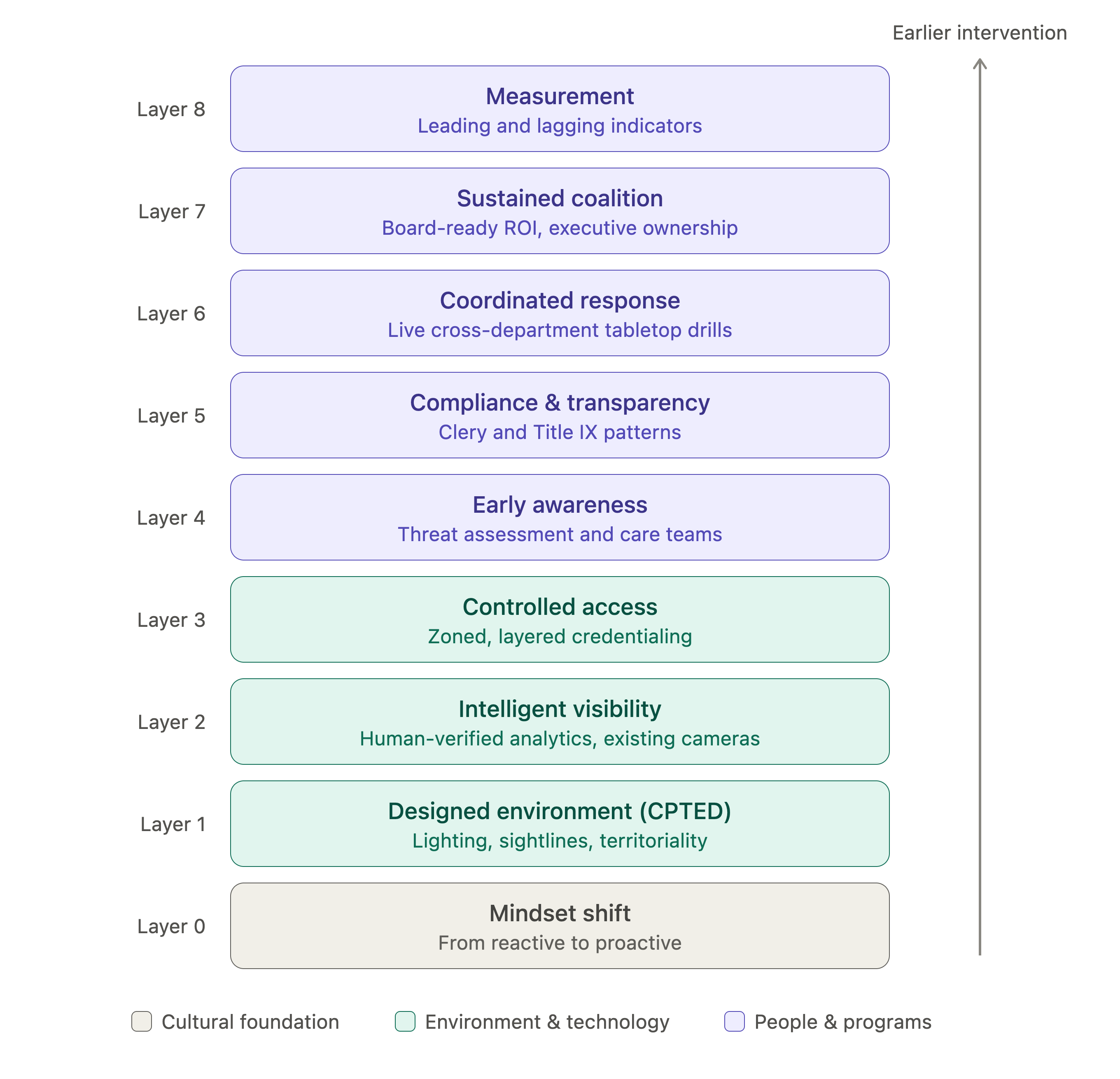
Layers 1 through 3 reduce physical opportunity: a proactive mindset, a well-designed environment, cameras that actually notice, doors tiered to the risk they carry. Layer 4 reduces something different: the chance that a person in crisis goes unnoticed long enough to reach one of those physical layers at all. It is why access control feeds this layer instead of standing apart from it. An unusual access pattern a badge system flags, or a fight a camera catches before it escalates, is exactly the kind of information a care team should see. Layer 5, coming next in this series, is what compliance data like Clery Act and Title IX reporting can add to that same picture. The layers are not separate systems. They are one program, built up one decision at a time.
The bottom line
You cannot buy early awareness. You build it, one trusted reporting pathway at a time. The best technology available will not notice that a student has stopped eating in the dining hall or given away his headphones. A roommate will. A coach will. A resident advisor will. Your job is to make sure that when they do, they know exactly who to call, and that calling feels like help, not an accusation.
Frequently asked questions
What is a behavioral threat assessment team?
A behavioral threat assessment team, often called a BIT or care team, is a standing multidisciplinary group, typically drawing from Public Safety, Student Affairs, Counseling, and legal counsel, that meets regularly to review reported concerns about a student's or employee's behavior, assess the level of risk, and coordinate an appropriate response.
Who should be on a campus care team?
Most effective teams include representatives from campus law enforcement or Public Safety, the Dean of Students or Student Affairs office, Counseling or behavioral health, and legal counsel, with Residence Life, Title IX, and Human Resources looped in on cases that touch their areas. The team also needs a senior administrator sponsoring it, since teams without cabinet-level backing tend to stall on contested cases.
How do we get students and staff to actually report concerns?
Make the reporting pathway simple, publicize it constantly in places people actually look, and be visibly consistent about routing reports to support rather than discipline. Trust builds when people see that reporting a friend led to that friend getting help, not getting in trouble.
Is this the same as profiling?
No. A properly run threat assessment process evaluates specific, observable behavior over time, not a person's identity, background, or group membership. Programs that veer into profiling are considered a failure of the model, not an example of it, and any technology used to support this work should be built the same way, flagging behavior rather than identity.
What happens after a report comes in?
The care team reviews the information, gathers additional context if needed, and assesses the level of concern. Most cases resolve with a wellness check, a referral to counseling, an academic accommodation, or continued monitoring. A small number of higher-risk cases involve law enforcement or more formal intervention, but that is the exception, not the default outcome.
Do we need new technology to start a threat assessment program?
No. A care team can and should start with people and process: a clear reporting pathway, a trained multidisciplinary team, and a defined review workflow. Technology like VOLT's video intelligence platform is a force multiplier once that foundation exists, surfacing verified behavioral signals the team can act on, drawn from real customer programs already running it that way, not a prerequisite for getting started.
This is Part 5 of "How to Proactively Protect Your Campus." Next in the series: Part 6 turns Clery Act and Title IX compliance into a prevention engine instead of a paperwork exercise. Catch up on Part 1, Part 2, Part 3, and Part 4 here.