Insights


Schools with Cisco Meraki cameras face a common decision point: replace aging hardware or find a smarter way to maximize existing infrastructure. Adding AI security software to your current Meraki cameras transforms passive surveillance into proactive threat detection, without the capital expense and disruption of a full hardware upgrade.
The Hardware Upgrade Trap
School administrators face constant pressure to modernize security infrastructure. When Meraki cameras reach end-of-life or when new features become available, the instinct is often to replace hardware. This approach sounds logical on the surface. Newer cameras should mean better security.
The reality is more complicated. Hardware upgrades deliver diminishing returns for school security. A higher-resolution camera still requires someone to watch it. A wider field of view still captures footage that sits unreviewed until after an incident occurs.
Most schools already have cameras in the right places. The problem is not what the cameras can see. The problem is that no one is watching.
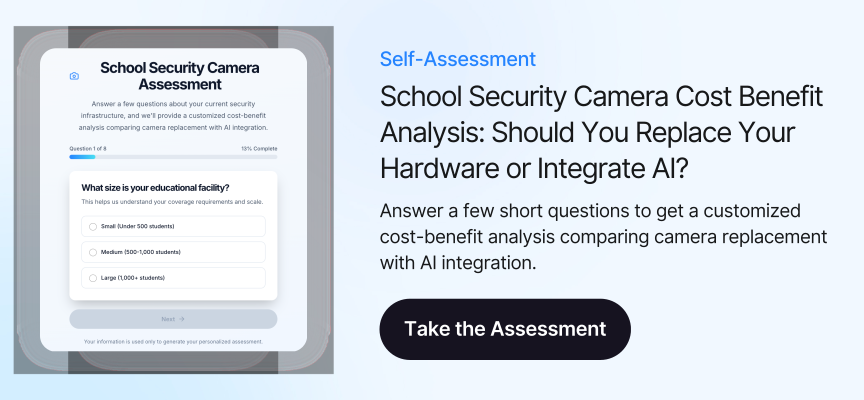
Take our School Security Camera Assessment.
What Your Meraki Cameras Actually Need
Your existing Meraki camera infrastructure likely captures quality footage across your campus. The footage exists. The coverage exists. What is missing is the intelligence to act on what those cameras observe in real time.
Consider what happens today when an incident occurs at your school. Staff members review hours of footage after the fact. They piece together timelines from multiple camera angles. The investigation takes days or weeks. The incident itself happened without anyone noticing until it was too late.
AI-powered video intelligence software changes this equation entirely. Rather than replacing your Meraki cameras, you add a layer of artificial intelligence that monitors every feed simultaneously. The software detects threats the moment they appear and alerts your team within seconds.
How AI Security Software Works With Meraki Cameras
VOLT AI integrates with existing camera infrastructure regardless of manufacturer, age, or installation date. This includes Cisco Meraki cameras alongside whatever other equipment you have accumulated over the years.
Schools rarely have uniform camera fleets. Budget cycles, construction projects, and changing priorities mean most campuses operate with cameras from multiple vendors installed across different years. VOLT AI connects to this mixed environment through a single integration point.
The technical requirements are straightforward. VOLT AI works with any IP camera system, including the full Meraki MV series. Your Meraki cameras connect through your existing network infrastructure. No camera replacement is necessary. No additional hardware purchases are required beyond the VOLT AI integration device.
|
Consideration |
Hardware Upgrade |
AI Software Addition |
|
Implementation timeline |
Weeks to months |
Days |
|
Capital investment |
High (new cameras, installation, cabling) |
Low (software licensing) |
|
Disruption to operations |
Significant (physical installation) |
Minimal (software deployment) |
|
Staff retraining |
Required for new interface |
Intuitive dashboard, minimal training |
|
Mixed camera support |
Must standardize fleet |
Works with existing mix |
|
Monitoring capability |
Still requires human operators |
AI monitors 100% of feeds 24/7 |
Detection Capabilities That Hardware Cannot Provide
New cameras capture better images. AI software understands what those images contain. This distinction matters enormously for school safety.
VOLT AI's detection capabilities include threats that no camera upgrade can address on its own. The system identifies weapons including firearms held at a person's side or partially concealed. It recognizes fights as they begin rather than after they escalate. It detects when someone falls and needs medical attention.
These capabilities exist because the software has been trained on extensive datasets representing real-world scenarios. The AI recognizes patterns that human operators might miss, especially during the long hours when attention naturally wanders.
Related Content:
- School Security Camera Systems: Integration vs. Replacement
- Leveraging Existing School Security Camera Infrastructure: A Technical Guide
- School Security Camera ROI: Measuring What Actually Matters
- Real-Time Intelligence: How AI Transforms Security Cameras in Schools from Reactive to Proactive
- Security Camera Implementation: Hardware Deployment vs. Software Integration Timelines
- Future-Proofing School Security: Why Software Ages Better Than Hardware
What AI Detection Adds to Your Meraki Camera System
AI security software transforms standard Meraki camera feeds into an intelligent monitoring system. Here is what becomes possible:
- Weapon detection: Firearms, knives, and other dangerous weapons identified in real time, even when partially visible
- Fight detection: Physical altercations recognized immediately, enabling intervention before escalation
- Person down detection: Medical emergencies identified when someone falls or becomes unresponsive
- Crowd gathering: Unusual congregations that may indicate developing conflicts
- Loitering detection: Individuals in restricted areas or lingering in sensitive locations
- Unauthorized access: People present in areas during prohibited times
Get answers from real schools about AI security camera software integration.
The Cost Reality Schools Need to Understand
Budget conversations around security often focus on hardware because hardware has clear line-item costs. Software licensing feels less tangible. This perception obscures the true economics of school security.
A hardware upgrade project requires capital expenditure for cameras, installation labor, potential network infrastructure upgrades, and ongoing maintenance contracts. Meraki cameras range from approximately $500 to $1,500 per unit, with additional licensing costs that can add $1,000 or more per camera depending on the subscription term. The total investment for a comprehensive camera replacement can reach six or seven figures for larger schools.
VOLT AI pricing is transparent and calculated per camera stream. Schools can review exact costs on the VOLT AI pricing page before any sales conversation. The investment typically costs less than hiring a single full-time security employee, yet provides monitoring capability across every camera on campus around the clock.
Real Schools, Real Results
Robinson Independent School District in Texas faced the same decision many schools encounter. They had invested in cameras across their campuses. Those cameras worked well as forensic tools after incidents occurred. What they lacked was real-time awareness.
After implementing VOLT AI, David Wrzesinski, the district's Safety Director, described the transformation. The system connected to their existing cameras within two weeks. Within that time, they gained capabilities that no hardware upgrade could have provided.
"We have kind of a hodgepodge of cameras, every campus put in at different times with different cameras... and it worked seamlessly," David explained. The mixed camera environment that might have required standardization for other solutions worked immediately with VOLT AI.
At Prescott High School in Arizona, Principal Adam Neely experienced a similar shift from reactive to proactive security. The school had cameras. They had a school resource officer. They had a state-funded silent alarm system. What they did not have was awareness of incidents as they happened.
"Everything I was doing felt like chasing my tail," Adam noted. "Now I can take a peek at my watch and react to something and really get there and intervene before something happened."

Visit our School Security Camera Resource Center.
What Implementation Actually Looks Like
Schools considering AI security software often worry about implementation complexity. IT departments already manage heavy workloads. Adding another system sounds like adding another burden.
The reality at schools using VOLT AI has been different. Implementation typically takes two to three weeks from decision to live system. The process involves minimal IT lift because VOLT AI works with existing network infrastructure.
At Robinson ISD, David described the process as remarkably efficient. "It was literally 2 or 3 meetings and we got maps to them and got things that they needed and we were testing." His IT team, initially skeptical, became advocates for the solution.
Implementation Process for Meraki Camera Integration
The process of adding AI capabilities to your existing Meraki cameras follows a straightforward path:
- Initial assessment: VOLT team reviews existing camera infrastructure and identifies integration points
- Facility mapping: 3D mapping of campus creates visual context for alerts and tracking
- System connection: VOLT AI device connects to existing camera network
- Rule configuration: Detection parameters customized for your campus and needs
- Staff training: Dashboard walkthrough and alert response protocols established
- Go-live: System begins monitoring with human-validated alerts
The Question Worth Asking
Before approving a hardware upgrade budget, school administrators should ask a different question. The question is not whether new cameras would capture better footage. The question is whether anyone would be watching that footage when it matters.
Hardware upgrades assume the limitation is image quality. For most schools, the limitation is attention. Even the best security staff cannot monitor dozens or hundreds of camera feeds simultaneously. Human attention degrades after twelve minutes of monitoring. After twenty-two minutes, operators miss the majority of relevant activity.
AI does not get tired. AI does not get distracted. AI monitors every camera, every second, every day. When something requires human attention, the AI identifies it immediately and alerts the right people.

Visit our School Security Camera Guide.
Making the Right Investment for Your Meraki Camera System
Your Meraki cameras represent a significant investment. They work. They capture footage. They cover your campus. The question is how to maximize the return on that existing investment rather than replacing it.
VOLT AI transforms what your cameras can do without touching the cameras themselves. The software adds intelligence to infrastructure you already own. It converts passive recording into active protection.
Schools that have made this shift describe it as transformative. The technology gives them capabilities they did not think were possible. It provides peace of mind that incidents will be caught in real time rather than discovered during post-incident review.
The next time a hardware upgrade proposal crosses your desk, consider the alternative. Your cameras might not need replacement. They might just need to get smarter.
Ready to see what AI can do with your existing Meraki cameras?
Schedule a demo to see VOLT AI working with camera infrastructure like yours. Pricing is transparent and available immediately.