Metal Detectors in Schools: The Complete Guide
How school metal detectors work, what they cost to run, where they help and where they struggle, and how they fit with the cameras and staff you have.
Metal detectors are one of the most visible decisions a school can make about safety, and one of the most debated. This guide covers what screening equipment actually does, what it costs to run once the hardware is paid for, where it helps, where it struggles, and how districts combine it with the cameras and people they already have.
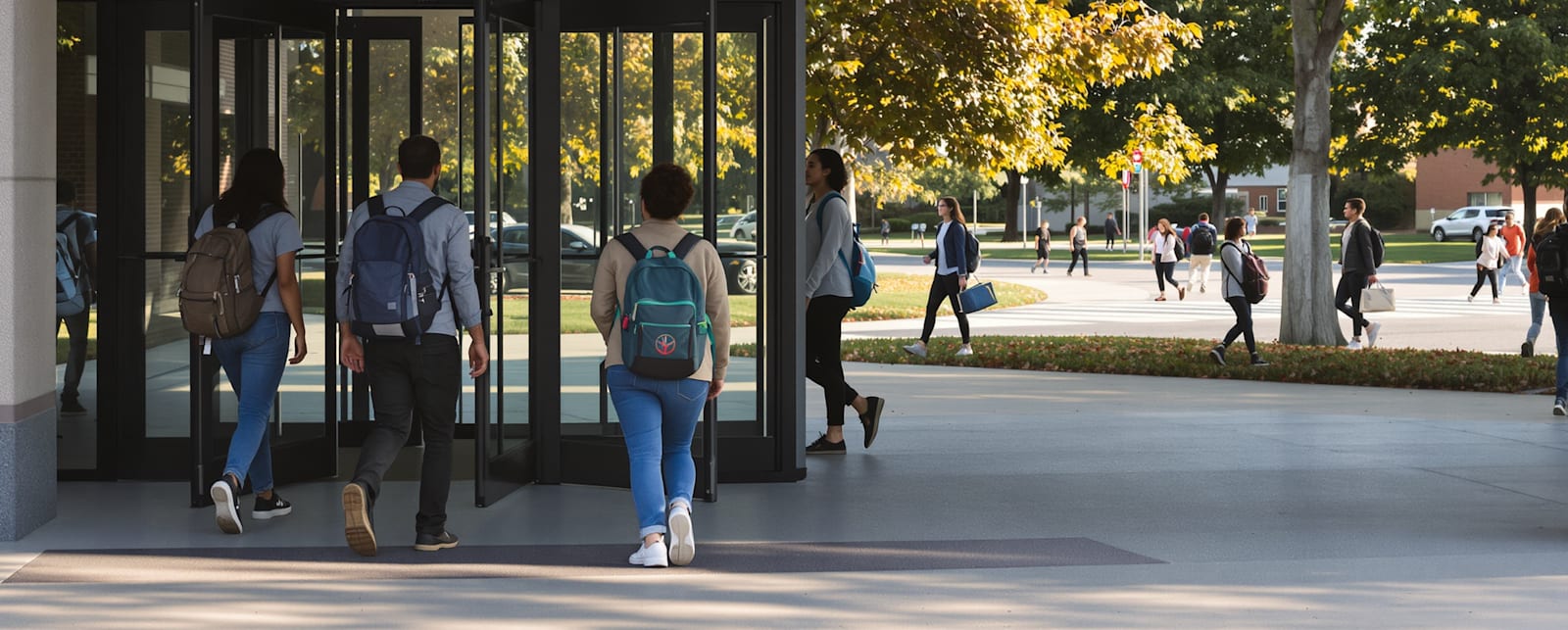
The three kinds of screening you will be quoted
"Metal detector" covers three quite different products, and vendors do not always draw the line clearly.
| Type | How it works | Realistic use |
|---|---|---|
| Walk-through arches | A fixed frame detects metal mass as a person passes through. | A single supervised entrance, staffed for every arrival period. |
| Handheld wands | Staff sweep an individual after a prompt or a random selection. | Secondary checks, spot checks, event entry. |
| Weapons detection systems | Sensors plus software aim to flag specific shapes rather than all metal, so bags can often stay closed. | Higher-throughput entries where queueing is the constraint. |
The third category is the one most often described loosely as "AI screening". It is still a physical checkpoint: someone has to walk through it, and someone has to respond when it alerts.
What screening does well
It is visible, and visibility reassures
A checkpoint is something families, staff and school boards can see. After a frightening incident, that visible response matters, and it is a legitimate reason to consider screening. It signals that arrival is supervised and that someone is paying attention.
It concentrates attention at one point
Screening works best where a building genuinely has one controlled way in — a single-entry high school, an events venue, an athletics gate. Within that narrow frame, it does the job it was designed for.
It gives staff a clear procedure
A checkpoint comes with a script: who stands where, what happens on an alert, who is called. That clarity is worth something on a difficult morning.
Where screening struggles
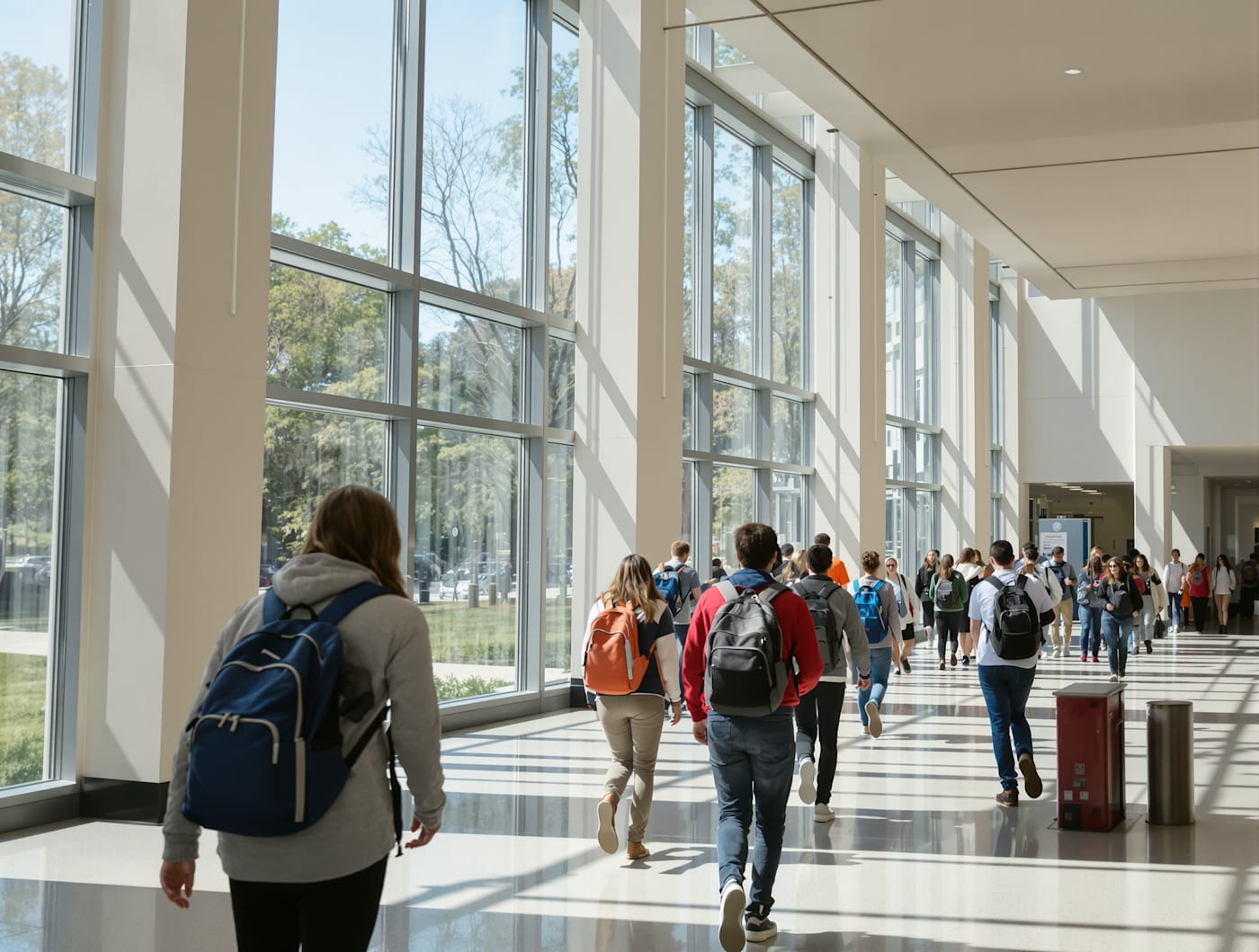
Arrival is short, and queues are long
The practical question is not whether the equipment detects metal. It is how many people arrive in the ten or fifteen minutes before the first bell, how many lanes you can staff, and how long each person takes. Work that arithmetic for your own school before anything else: total arrivals, lanes available, seconds per person. If the answer pushes students outside in a queue, screening has moved the crowd rather than protected it.
Coverage ends when the checkpoint closes
Most incidents on a campus do not arrive through the front door during the screening window. Propped side doors, deliveries, athletics entrances, after-hours events and the long afternoon after staff have stood down are all outside the checkpoint's reach.
The recurring cost is people, not equipment
Hardware is a one-time line item that budgets handle well. Staffing is the number that repeats every year. Two to four adults at an entrance for the arrival period, every school day, is the real cost of screening, and it competes directly with counsellors, aides and campus supervisors.
Everyday objects set it off
Laptops, binder rings, instrument cases, umbrellas, phones and water bottles all trigger conventional detectors. Frequent harmless alerts train staff to move people through quickly, which is exactly the habit a checkpoint is meant to prevent.
Students experience it every single day
A checkpoint is the first thing a child meets each morning. Schools that use screening well pay close attention to the tone of that interaction, because the same equipment can read as "someone is looking after us" or as "we are suspects", depending entirely on how it is run.
What it actually costs to run
When you compare quotes, compare these five lines rather than the hardware price alone.
- Equipment — units per entrance, plus spares.
- Installation and power — electrical work, weather protection, and the vestibule changes that often follow.
- Staffing, every year — the adults needed per lane per arrival period. This is usually the largest number over five years.
- Training and turnover — screening quality depends on the person, and entrance staff turn over.
- Time — minutes of instruction lost per student per day, multiplied across a year.
If you are weighing screening against getting more from the cameras you already own, our school camera cost calculator gives you a like-for-like estimate in about two minutes.

Questions to ask any screening vendor
- How many people per minute, per lane, in independent testing — and at what alert rate?
- What is the alert rate with a typical student backpack containing a laptop and a binder?
- How many staff does the vendor assume at each lane? Does the quote include them?
- What happens at the entrances this system does not cover, and during the hours it is not staffed?
- What is the documented procedure when it alerts, and who carries it out?
- What are the five-year costs including staffing, service and replacement parts?
- Which comparable districts have run it for a full year, and may we speak with them?
How screening fits with cameras and people
Screening and camera-based detection answer different questions, which is why the sensible comparison is rarely one against the other.
| Question | Entry screening | Camera-based detection |
|---|---|---|
| Where does it apply? | One supervised entrance | Anywhere there is already a camera |
| When does it apply? | While it is staffed | Continuously, including after hours |
| What does it notice? | Metal, or flagged shapes, on a person | A medical emergency, a fall, a fight, a person somewhere they should not be, or a visible weapon |
| What does it cost each year? | Mostly staffing | Mostly software, on existing hardware |
| What does a student feel? | A queue and a check, daily | Nothing different |
A checkpoint watches one door for part of the day. Cameras already cover the hallways, car parks, fields and stairwells for all of it — they are simply not watched, because no one can watch hundreds of feeds at once. That is the gap software is useful for: it reviews the feeds continuously and raises the handful of moments worth a person's attention.
At VOLT a trained person reviews every alert before it reaches your staff, so what arrives is a verified situation with a location and a clip, not a buzzer. We look at behaviour and circumstance — someone on the ground, a fight forming, a door held open, a visible weapon — and we do not use facial recognition. See how it works.
A reasonable way to decide
- Map your entrances and your hours. Count the ways in, and the hours each is in use. Screening only addresses what it covers.
- Do the arrival arithmetic. Arrivals, lanes, seconds per person. If the queue does not fit the schedule, adjust the plan before buying.
- Price five years, not one. Put staffing in the model. Compare it against what the same money funds in people or software.
- Cover the rest of the campus and the rest of the day. Whatever you choose at the door, decide what happens everywhere else.
- Ask students and staff. The people walking through it every morning will tell you quickly whether it feels like care or suspicion.
Frequently asked questions
Do metal detectors make schools safer?
The honest answer is that they help with a specific, narrow problem — items carried through one supervised entrance while that entrance is staffed — and they do nothing about anything else. Research on school screening has not produced a clear finding that detectors by themselves reduce violence, which is why most districts treat them as one layer rather than a solution.
How many schools use metal detectors?
A minority. Federal data collected by the National Center for Education Statistics has consistently shown that only a small share of US public schools screen students with metal detectors, and that random wand checks are more common than daily walk-through screening.
How long does screening take per student?
It depends on the equipment and the alert rate, so ask vendors for tested throughput per lane rather than accepting a general figure. Then check it against your own arrival numbers, which is where most plans succeed or fail.
Can we use screening and AI cameras together?
Yes, and many districts do. Screening covers the controlled entrance; camera-based detection covers the rest of the site and the rest of the day. They overlap very little.
Will screening work with the cameras we already have?
Screening is separate equipment at the door. If your question is whether your existing cameras can do more, that is usually a software question rather than a hardware one — see School Security Cameras: Why Intelligence Matters.
What does this cost compared with adding AI to existing cameras?
Screening costs are dominated by recurring staffing; software costs are usually per camera stream per month. Our pricing page lists current rates, and the cost calculator compares the two approaches for your camera count.
Further reading
See VOLT on your own cameras.
A short call, your sites, and a clear view of what VOLT would notice.
No commitment · Runs on the cameras you already have