
This article is part of our K-12 Campus Security Master Plan series. Learn more about the K-12 Campus Security Master Plan resources and take the assessment here.
The 93% Statistic That Hides a Deeper Problem
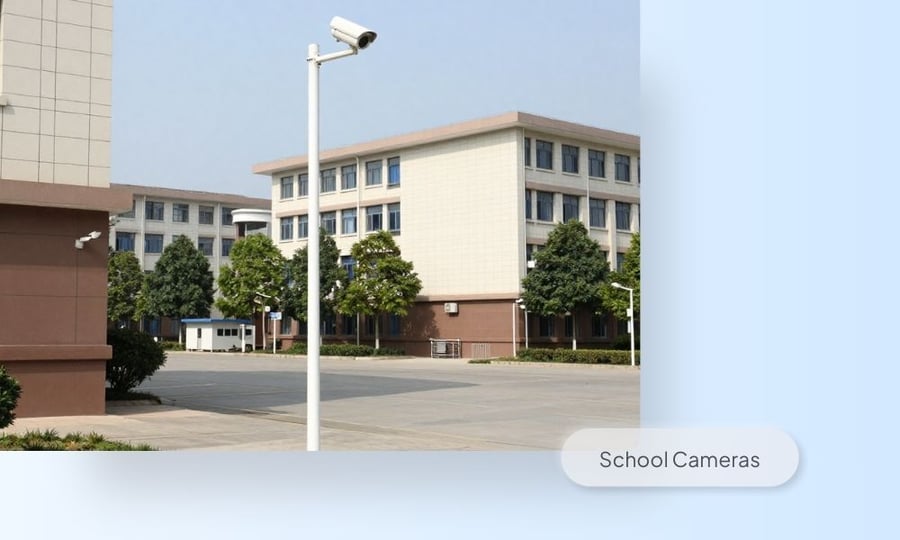
Ninety-three percent of public schools in the United States use security cameras to monitor their campus. On the surface, that number sounds reassuring. Nearly every school in the country has invested in video surveillance infrastructure.
The number hides a more complicated reality. Having cameras installed and having a functioning video monitoring capability are two fundamentally different things. Most school cameras record continuously to a digital video recorder (DVR) or network video recorder (NVR) that stores footage for a set number of days. When an incident occurs, someone retrieves the footage, scrubs through it, and uses it for investigation or documentation.
That process is valuable for post-incident review. It is not security. It’s record-keeping. The Camera Master Security Plan (CMSP) framework classifies this as Level 1 video monitoring maturity: cameras record, nobody watches, device health is unknown, and retention is measured in days.

The Human Attention Problem
The reason most school camera systems go unmonitored isn’t neglect. It’s math.
Research on human monitoring performance shows that operators miss roughly 50% of security-relevant activity after just 12 minutes of continuous monitoring. After 22 minutes, that number climbs to 95%. The human brain wasn’t designed for sustained visual surveillance across multiple camera feeds. Attention drifts, fatigue sets in, and the most critical moments get missed precisely because they’re rare.
Most K-12 districts don’t have the budget to staff a dedicated monitoring room. Even districts that employ security officers assign them to physical patrols, front-desk coverage, or parking lot duty. Asking those same officers to simultaneously watch a wall of camera feeds ensures that neither task gets done effectively.
The math tells a clear story: the traditional model of human-monitored camera systems doesn’t scale for K-12 environments. A different approach is needed.
From Cameras to Intelligence: The Five Levels of Video Monitoring Maturity
The CMSP framework traces a clear progression from basic camera installation to intelligent, AI-powered monitoring. Each level represents a meaningful increase in capability and a corresponding improvement in safety outcomes.
Maturity Level | What It Looks Like | Typical K-12 Reality |
Level 1: Reactive | Cameras record to DVR. Nobody watches live feeds. Device health is unknown. Retention is days, not weeks. | This is where most districts land. Cameras exist but produce no real-time value. |
Level 2: Developing | Centralized VMS deployed. 30+ day retention. Some live monitoring during school hours. Basic motion detection enabled. | Larger districts and those with dedicated security staff sometimes reach this level. |
Level 3: Defined | Comprehensive coverage mapped to facility layout. Defined monitoring protocols. Trained staff assigned to monitoring roles. Exterior areas covered. | Rare in K-12 without significant staffing investment. |
Level 4: Optimized | AI-powered analytics process every feed in real-time. Automated threat detection generates alerts. Integration with access control and response systems. 24/7 monitoring without proportional staffing. | Achievable with AI software layered onto existing infrastructure. This is where the transformation happens. |
Level 5: Managed | Predictive analytics identify patterns before incidents occur. Behavioral analysis enhances threat assessment. Automated reporting provides continuous operational intelligence. | Sustained optimization through continuous improvement and data-driven refinement. |
The most important observation from this table is the jump between Level 2 and Level 4. Without AI, reaching Level 3 requires dedicated monitoring staff, defined protocols, and consistent coverage, all of which are expensive and staffing-dependent. AI-powered analytics allow districts to leapfrog directly to Level 4 capabilities because the technology handles continuous monitoring across every camera feed simultaneously.
What Level 4 Actually Looks Like in a School
Understanding what advanced video monitoring delivers requires moving past abstract maturity levels into concrete daily operations.
A district operating at Level 4 video monitoring has AI software processing every camera feed in real time, 24 hours a day, 7 days a week. The system doesn’t replace human judgment. It augments it. AI watches everything, identifies events that require human attention, and routes alerts to trained responders who focus on verification and action.
Here’s what that means in practice across different scenarios.
Weapon Detection
AI-powered video analytics can identify a firearm in a camera feed within seconds, often before the individual carrying it reaches a building entrance. The system generates an immediate alert to designated responders with the camera location, a visual of the detected threat, and real-time tracking of the individual’s movement through the facility. At Aspen Academy, the system detected a weapon and sent a notification to staff before the individual even reached the school entrance.

Read our AI Gun Detection Guide.
Medical Emergency Response
A “Person Down” detection capability identifies when an individual has fallen or appears to be in medical distress. At Prescott High School, this feature detected a student suffering an asthma attack in an empty hallway and enabled a nurse response within 15 seconds. Without AI monitoring, that student might not have been found until someone happened to walk through that corridor.
Fight and Behavioral Detection
AI can identify physical altercations as they begin, alerting staff to respond within seconds rather than minutes. Early intervention reduces the severity of fights and limits the potential for injury. The system can also detect unusual crowd formations that might indicate developing conflicts.
After-Hours Monitoring
School campuses face security risks outside of school hours when buildings are supposed to be empty. AI monitoring detects unauthorized access, loitering, and suspicious activity during nights, weekends, and breaks without requiring security staff to be physically present. The system alerts responders only when human attention is needed.
The Force Multiplier Effect
The concept of a “force multiplier” comes from military strategy. It describes a capability that makes an existing force dramatically more effective without increasing its size. In K-12 security, AI-powered video monitoring is precisely that.
Consider the staffing math. Without AI, effective real-time camera monitoring requires one operator for every 4-8 cameras. After 22 minutes, that operator is missing 95% of relevant activity anyway. A district with 100 cameras would need 12-25 dedicated monitoring staff to achieve consistent human coverage. That’s not realistic for any K-12 budget.
With AI monitoring, the ratio changes completely. AI watches all cameras simultaneously and never loses attention. Staff respond to alerts rather than staring at screens. Alert response capacity becomes the constraint (roughly 10-20 alerts per hour per responder), and a 3-person security team becomes functionally equivalent to a much larger operation.
Learn from school administrators who've implemented video monitoring solutions.
The Infrastructure You Already Have Is Enough
One of the most common misconceptions about advanced video monitoring is that it requires new cameras. For the vast majority of districts, the existing camera infrastructure is sufficient.
Most modern IP cameras produce video quality that is more than adequate for AI-powered analytics. The intelligence doesn’t live in the camera hardware. It lives in the software that processes the video feed. This distinction matters enormously for budget conversations, because it means the path from Level 1 to Level 4 is a software investment, not a hardware replacement project.
Districts that have invested in camera infrastructure over the past decade have already made the foundational capital expenditure. AI monitoring software activates the value of that investment by transforming passive recording devices into active safety sensors.
Making the Case: Video Monitoring ROI
Video monitoring is almost always identified as a quick win in security planning because the return on investment is both rapid and measurable.
The metrics that matter extend beyond incident detection. Districts implementing AI-powered video monitoring consistently report improvements across several dimensions.
- Response time reduction: The gap between an incident occurring and staff responding shrinks from minutes or hours to seconds. This improvement applies across threat types, from weapons to medical emergencies to unauthorized access.
- Coverage expansion: A small security team can monitor an entire campus, including areas that were previously unmonitored during off-hours, breaks, and transitions.
- Incident prevention: Real-time detection enables intervention before situations escalate. Fights are broken up sooner. Medical emergencies receive faster attention. Unauthorized individuals are identified before they reach occupied areas.
- Documentation quality: AI-generated incident records provide timestamped, location-tagged documentation that supports post-incident review, reporting, and legal proceedings.

From Reactive Recording to Proactive Protection with VOLT AI
VOLT AI transforms existing security camera infrastructure into an intelligent monitoring system that operates around the clock. The platform layers AI-powered analytics onto the cameras a district already owns, delivering real-time detection for weapons, medical emergencies, fights, unauthorized access, and behavioral anomalies.
The deployment model matters for districts evaluating this transition. VOLT AI integrates with the majority of existing IP camera systems without requiring hardware replacement. The platform’s serverless architecture minimizes network complexity, and deployment timelines are measured in weeks rather than months.
For districts that have been operating at Level 1 video monitoring, the capability leap is immediate and measurable. Cameras that were recording to a DVR nobody checked become active sensors feeding real-time intelligence to trained responders. The 93% of schools that already have cameras are sitting on the infrastructure they need. The missing piece is the intelligence layer.
Every second matters in school safety. Partner with VOLT AI to transform your cameras from passive recorders into proactive guardians. Schedule a demo today.