Insights


When most people think about campus security, they imagine guards, cameras, and incident reports. Raphaella Prange sees something different. She sees an opportunity to help students become who they're meant to be.
As Vice President for Student Life at Maryville University in St. Louis, Prange oversees what amounts to a small city. Athletics. Student wellness. Dining services. Residential life. Title IX. Accessibility. Public safety. The breadth of her portfolio would overwhelm most administrators. She turned it into a strategic advantage.
Redefining What Campus Safety Means
Prange's unconventional approach starts with a simple question: What if campus safety wasn't just about stopping bad things, but helping students thrive?
This philosophy shapes everything about how Maryville approaches security. The university deliberately positioned public safety within student affairs rather than treating it as a separate administrative function. The result is a developmental, community-centered approach to protection that transforms potential enforcement moments into opportunities for growth.
"We don't just protect students. We help them become who they're meant to be," Prange explains.
The Challenge of Protecting a Growing Campus
Maryville serves over 1,000 residential students alongside 3,500 commuters and approximately 5,000 online learners. The campus spans 23 occupied buildings with perimeter fencing and two primary road entrances that see roughly 3,500 vehicles pass through daily.
An 11-person security team bears responsibility for all of it.
Before implementing AI-powered security, most camera footage went unmonitored in real time. The team simply couldn't be everywhere at once. And Prange recognized that this gap wasn't just a security vulnerability. It meant missing opportunities to identify and help struggling students before situations became critical.
"With our small staff, we can't possibly be everywhere at the same time," Prange notes. "We weren't monitoring everything before. Now VOLT allows us to have our eyes and ears in most places."
From Innovation Vision to Campus Reality
Prange's decision to implement VOLT AI wasn't triggered by a specific incident. It emerged from a strategic vision to infuse artificial intelligence across every aspect of campus operations.
With a student body deeply engaged in STEM disciplines, data science, and cybersecurity, Maryville saw an opportunity to demonstrate innovation in campus safety while delivering tangible protection benefits. The system needed to work with existing infrastructure. Other vendors would have required a complete camera system overhaul with price tags approaching $1.4 million.
What Prange found in VOLT AI was a partner who shared her developmental philosophy. The technology integrates with existing cameras, provides human-validated alerts to eliminate fatigue, and most importantly, enables the kind of early intervention that can change a student's trajectory.
Wrap-Around Care: Security as Student Support
The real power of Prange's approach becomes clear in how Maryville uses its enhanced capabilities. The system detects medical emergencies and welfare concerns, allowing the university to identify struggling students and connect them with resources before situations become critical.
This proactive approach directly supports retention goals by enabling early intervention and wrap-around care.
"If we can identify a struggling student through VOLT and get them help before they drop out, fail classes, or something worse happens, that's where your real advantage is," Prange explains.
The philosophy extends throughout the organization. Security encounters become educational opportunities. Protection serves development. Technology amplifies human care rather than replacing it.
Building Something Bigger Than Security
Prange's vision has sparked collaboration across campus departments. Teams beyond security are identifying additional use cases that extend the value of AI-powered monitoring.
Labs with expensive equipment benefit from after-hours surveillance. Facilities management gained water intrusion detection capabilities. Athletic events now have occupancy and density data. Summer youth camps operate with enhanced monitoring.
The common thread through all of it: technology in service of community wellbeing.
The Wizard of Wellness
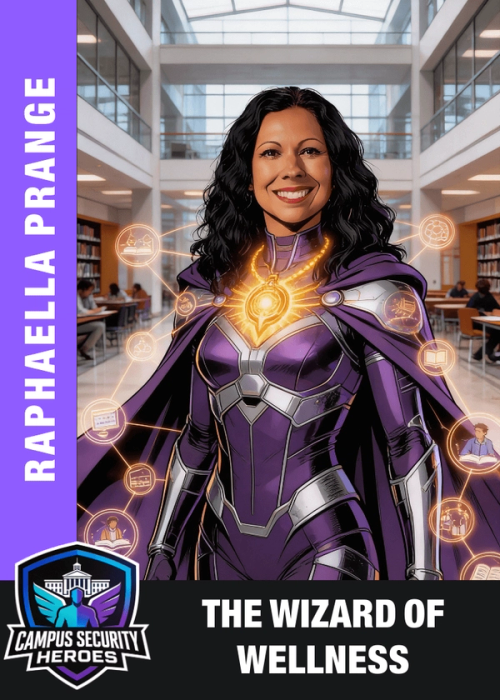
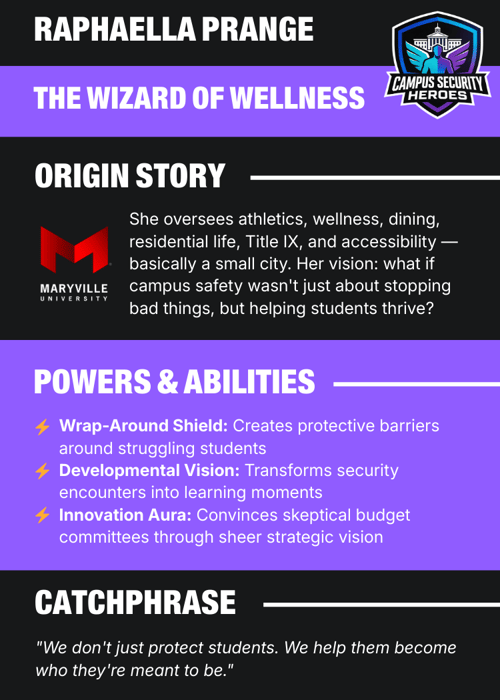
Among campus security professionals, Prange has earned a distinctive reputation. Her ability to transform security investments into comprehensive student support systems requires a rare combination of strategic vision, political savvy, and genuine care for student outcomes.
She convinces skeptical budget committees through sheer strategic alignment. She creates protective barriers around struggling students. She turns every security interaction into a potential developmental moment.
In a field often focused exclusively on preventing bad outcomes, Raphaella Prange reminds us that true protection means helping people flourish.