


When Cameras Capture Everything But a Face
The Brown University community continues grieving this week after a mass shooting claimed two students' lives and injured nine others. As the investigation stretches into its fifth day, authorities face a familiar and frustrating reality: extensive camera coverage, limited usable footage.
Homeland security expert Juliette Kayyem, faculty chair of the Homeland Security Project at Harvard's Kennedy School of Government, highlighted this challenge in her NPR interview following the tragedy. The shooter moved through areas with limited surveillance, wore a mask, and left behind only grainy footage showing a figure from behind.
"Unless you know the person's gait, you're not going to come forward and say, I know who that person is," Kayyem observed.
That single comment points to a fundamental shift happening in security technology. When traditional identification methods fail, behavioral analysis becomes the critical investigative pathway.
Understanding Gait Analysis in Security Applications
Gait refers to the distinctive way a person walks. Everyone has a unique movement signature composed of stride length, walking speed, arm swing, posture, and dozens of micro-movements that remain remarkably consistent across time and environments.
Security researchers have studied gait as a biometric identifier for decades. Unlike fingerprints or facial features, gait can be observed from a distance without subject cooperation. A person can change their clothes, cover their face, or alter their hairstyle. Their walking pattern remains largely unchanged.
The challenge has always been implementation. Human observers can recognize familiar gaits intuitively, but analyzing movement patterns from security footage requires sophisticated computer vision capabilities that only recently became practical at scale.
Identification Method | Requires Subject Cooperation | Works at Distance | Works When Face Obscured | Privacy Concerns |
Facial Recognition | No | Limited | No | High |
Fingerprint | Yes | No | N/A | Moderate |
Gait Analysis | No | Yes | Yes | Lower |
Behavioral AI | No | Yes | Yes | Lower |
How Modern AI Approaches Behavioral Tracking
Contemporary AI security systems approach identification differently than traditional surveillance. Rather than attempting to match faces against databases, these systems track behaviors, clothing characteristics, and movement patterns.
VOLT AI exemplifies this approach. The system tracks individuals based on gait and movement without using facial recognition technology. This methodology allows security teams to follow a person of interest across multiple camera feeds even when that person's face is never clearly visible.
The technical architecture involves several integrated capabilities:
- Real-time object tracking: Advanced algorithms track people and objects across multiple camera feeds simultaneously
- De-duplication technology: The system identifies when the same individual appears on different cameras, preventing confusion
- Adaptive learning: Environmental changes like lighting shifts or weather conditions are automatically compensated
- 3D facility mapping: Digital twin technology creates interactive models showing exactly where tracked individuals are located
This last capability proves particularly valuable during active incidents. Security personnel can see a suspect's real-time position on a three-dimensional map of their facility rather than mentally piecing together feeds from dozens of separate cameras.
Learn more about AI-powered video intelligence.

The Continuous Tracking Advantage
Most AI security systems lose track of subjects when primary identifying features disappear. Someone brandishes a weapon, triggers an alert, then conceals the weapon and walks away. Traditional systems have no way to maintain focus on that individual.
Advanced behavioral systems solve this problem through continuous tracking. Once the system identifies a person of interest through any trigger event, it maintains visual tracking as that person moves throughout the facility. The weapon can be hidden, the jacket can be changed, but the tracking continues based on accumulated behavioral data.
Lynda Sailor, Chief Financial and Operating Officer at Aspen Academy, observed this capability during testing. Alerts arrived before an individual carrying a weapon even reached the school entrance. This kind of advance warning transforms the response calculus entirely.
Privacy Through Behavioral Focus
One of the most significant advantages of behavioral AI lies in its privacy-preserving characteristics. These systems don't build databases of identified individuals or create permanent records of who was present at specific locations.
The Prescott High School implementation demonstrates this principle in practice. The system tracks concerning behaviors without ever identifying specific students. Parents and community members have responded positively specifically because the technology focuses on actions rather than identities.
This approach also sidesteps legal restrictions affecting facial recognition technology. Several states, including Illinois, have implemented stringent regulations around biometric data collection. Behavioral analysis operates outside these constraints because it doesn't collect biometric identifiers.
The privacy framework works as follows:
- AI monitors behaviors, not people: The system watches for concerning actions like weapons, fights, or medical emergencies
- Tracking uses general descriptors: Clothing colors, movement patterns, and location rather than personal identification
- Data encryption: All sensitive information remains fully encrypted
- No permanent identification: The system doesn't create records linking specific individuals to locations
From Reactive Investigation to Proactive Detection
The Brown University investigation illustrates the fundamental limitation of traditional security cameras. Footage exists, but investigators must manually review hours of video hoping to piece together a suspect's movements. This process consumes days or weeks while threats potentially remain active.
AI-powered systems invert this model entirely. Detection happens in real-time as events unfold. The University of Illinois Chicago implemented this approach across 142 camera streams covering their 250-acre urban campus.
The system provides immediate alerts for multiple incident types:
- Weapons detection: Firearms identified even when held at a person's side
- Medical emergencies: Individuals who have fallen or appear in distress
- Fighting and violence: Altercations detected as they begin
- Unauthorized access: People entering restricted areas
- Suspicious behavior: Extended loitering or unusual crowd formations
Each alert includes precise location information, relevant video clips, and continuous tracking if the situation develops. Security teams respond in seconds rather than discovering incidents hours later during routine footage review.
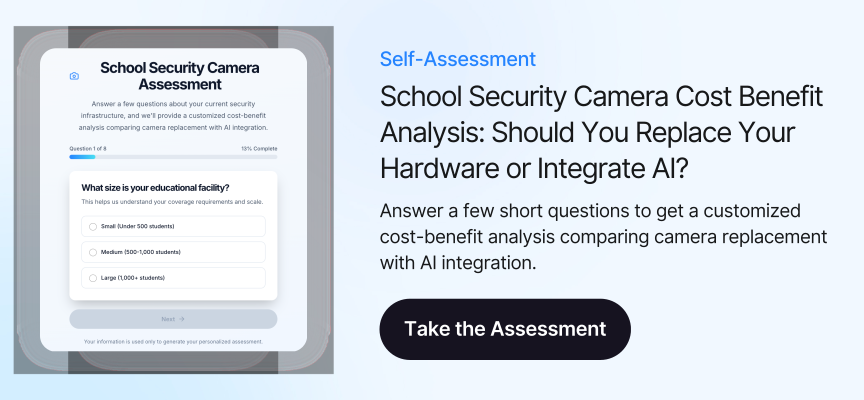
Use this self-assessment to understand your own university’s camera coverage.
The Human Validation Layer
Speed creates risk without accuracy. A system generating constant false alarms quickly becomes worthless as operators learn to ignore alerts. This "alert fatigue" phenomenon has undermined many security technology deployments.
Effective behavioral AI systems address this through human-in-the-loop validation. Trained operators review every potential detection before escalating alerts to security teams. This approach eliminates false positives while maintaining rapid response times.
The validation workflow operates as follows:
1. AI system detects potential threat 2. Alert routes to Security Operations Center 3. Trained analyst reviews footage within seconds 4. Confirmed threats escalate to appropriate responders 5. False positives are filtered without disturbing security teams
This hybrid approach combines AI's tireless monitoring capabilities with human judgment's contextual awareness. The result is a system that maintains vigilance across hundreds of cameras while sending alerts only for genuine concerns.
Learn more about preventing school shootings.

Questions Worth Asking About Campus Security
The Brown University tragedy raises difficult questions that every educational institution should consider. These aren't simple problems with obvious solutions, but the questions themselves point toward more thoughtful security planning.
Coverage completeness: Are there blind spots in your camera network? The Brown shooter apparently moved through areas with limited surveillance. Understanding gaps is the first step toward addressing them.
Real-time vs. forensic capability: Can your security team detect threats as they unfold, or are cameras primarily useful for after-the-fact investigation? The distinction affects both prevention and response.
Behavioral detection capabilities: Would your system recognize concerning behaviors like weapons brandishing, unusual access patterns, or violent altercations? Traditional cameras record everything but detect nothing.
Tracking continuity: If a threat is detected, can security personnel track that individual across your facility? Lost visual contact during an active incident costs precious response time.
Privacy considerations: How does your security approach balance monitoring effectiveness with privacy protection? This question increasingly affects both community acceptance and regulatory compliance.
Resources for Deeper Understanding
For those seeking to understand campus security technology more comprehensively, several resources provide valuable perspective:
- School Shooting Prevention Technology Resource Center: Comprehensive information about available security technologies and implementation considerations
- Gun and Weapon Detection Resource Center: Technical details about how AI systems identify weapons in video feeds
- Higher Education Security FAQs: Direct insights from university security professionals about implementation experiences
The Technology Exists
The gap between available security technology and deployed capabilities remains substantial across American educational institutions. Systems capable of real-time behavioral detection, continuous suspect tracking, and immediate alert escalation exist today. Many operate on existing camera infrastructure without requiring wholesale equipment replacement.
Whether institutions choose to implement these capabilities involves complex calculations around budget, privacy, community acceptance, and threat assessment. Those conversations deserve informed participants who understand what technology can and cannot accomplish.
When the next investigation depends on analyzing walking patterns from grainy footage, the question will be whether that analysis happens in real-time during the event or retrospectively during the manhunt that follows.