Insights


When Camera Gaps Become Headlines
The campus community at Brown University is grieving this week, and police chiefs across the country are asking a difficult question: could something like this happen on my campus?
Reports from the December 2025 incident have highlighted a critical vulnerability that exists at many institutions. The Barus & Holley engineering building, built in 1965, lacked surveillance cameras in the older sections where the shooting occurred. Officials noted that while newer additions to the building were equipped with cameras, the original structure remained largely unmonitored.
This situation raises an uncomfortable reality for campus police leadership. Many universities have accumulated camera systems over decades of piecemeal installations, creating an infrastructure landscape where coverage varies dramatically from building to building.
The Patchwork Problem in Higher Education Security
Campus police chiefs often inherit security infrastructure built across multiple budget cycles, administrations, and technology generations. The result is what security professionals call "coverage patchwork," meaning some areas have robust monitoring while others remain essentially blind.
Brown University's 1,200 security cameras might sound comprehensive for a campus. However, the university itself acknowledged that cameras "do not extend to every hallway, classroom, laboratory and office across the 250+ buildings on campus." This admission reflects a challenge shared by campuses nationwide.
The typical campus security infrastructure includes the following inconsistencies:
- Newer construction: Often built with integrated camera systems as part of modern building codes and security standards
- Mid-century buildings: May have retrofitted cameras at entry and exit points only, leaving interior spaces unmonitored
- Historic structures: Frequently lack any surveillance due to installation challenges or preservation concerns
- Outdoor spaces: Coverage often ends abruptly at building perimeters, creating transition zones with limited visibility
Why Building Age Should Not Determine Protection Levels
The explanation that older buildings lack cameras because of their age presents a logical gap that campus police chiefs should challenge. Building age affects installation complexity and cost, but it does not prevent surveillance capability.
Rhode Island Attorney General Peter Neronha noted that the shooting occurred in the "old part towards the back" of the building, where "there are fewer, if any, cameras in that location." This statement reveals an assumption worth examining. The 1965 building has functioned for 60 years with ongoing maintenance, renovations, and technology upgrades in other areas.
Consider the questions campus police chiefs should ask their facilities teams:
- When was the last comprehensive audit of camera coverage across all campus buildings?
- Are coverage decisions based on building age or on actual risk assessment?
- Do newer technology options exist that would make retrofitting older buildings more feasible?
- What blind spots currently exist between camera coverage zones?
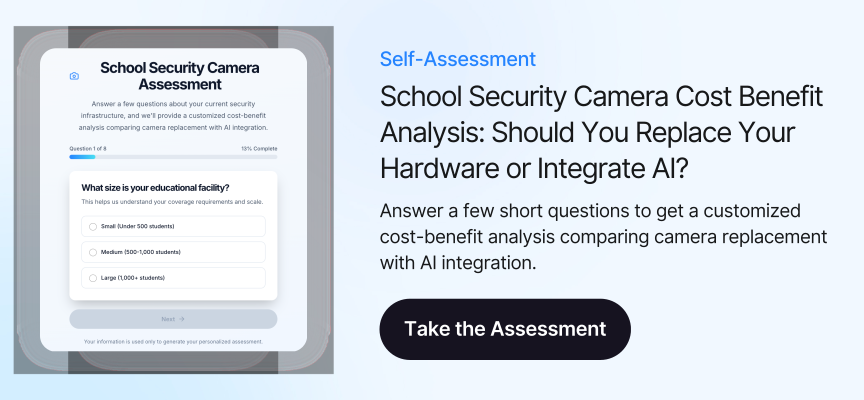
Use this self-assessment to understand your own university’s camera coverage.
Conducting a Coverage Gap Assessment
Campus police chiefs can take immediate action to understand their current surveillance landscape. A systematic assessment helps identify vulnerabilities before they become crisis points.
The assessment process should evaluate coverage across several dimensions:
|
Assessment Category |
Key Questions to Answer |
|
Building inventory |
How many structures lack any interior surveillance? |
|
Entry/exit coverage |
Are all access points monitored, including service entrances? |
|
Interior pathways |
Do cameras track movement through hallways and common areas? |
|
Transition zones |
Is there continuous coverage as individuals move between buildings? |
|
Time-based gaps |
Are cameras operational 24/7, including during low-activity periods? |
|
Integration capability |
Can existing cameras work with modern AI-powered monitoring? |
This type of assessment forms the foundation for informed budget requests and strategic security planning.
Learn more about preventing school shootings.
Understanding the Cost-Benefit Equation
Campus police chiefs face a fundamental decision when addressing coverage gaps. The choice typically comes down to two paths: replacing older cameras with new hardware or integrating AI-powered software that enhances existing infrastructure.
Complete camera replacement offers certain advantages, including uniform hardware, modern resolution, and updated connectivity. However, the costs escalate quickly when multiplied across dozens of buildings and hundreds of camera positions.
AI integration presents an alternative approach. Modern video intelligence platforms can connect to existing camera systems regardless of manufacturer or age, transforming passive recording devices into active monitoring tools. This path often allows campuses to expand effective coverage without the capital expenditure of wholesale hardware replacement.
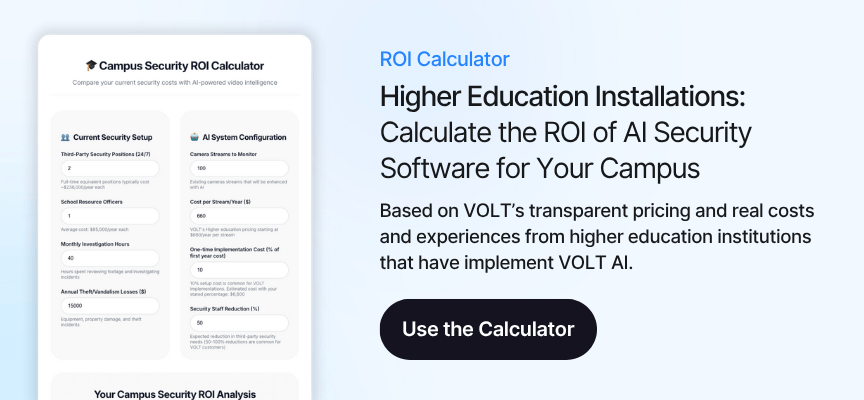
VOLT offers a free security camera assessment tool designed specifically for education administrators. The calculator helps police chiefs and security directors compare the costs of camera replacement versus AI integration based on their specific infrastructure profile.
Moving from Reactive to Proactive Security
Traditional camera systems serve primarily as forensic tools. They record footage that investigators review after an incident occurs. The Brown University situation demonstrates this limitation clearly. Without real-time monitoring, even comprehensive camera coverage cannot prevent or interrupt events as they unfold.
Providence Police Chief Col. Oscar Perez acknowledged there was "no clear video of the gunman from inside the engineering building where the shooting took place." This gap in actionable intelligence during the critical moments of an active incident illustrates the difference between having cameras and having camera intelligence.
AI-powered video intelligence transforms the security model in several ways:
- Real-time detection: Algorithms trained on threat indicators can identify weapons, fights, and anomalous behavior as they occur
- Immediate alerts: Security personnel receive notifications within seconds of detected incidents
- Continuous tracking: Once a person of interest is identified, the system can follow their movement across camera zones
- Human verification: Operators validate alerts before escalation, reducing false positives while maintaining rapid response
- 3D facility mapping: Campus police can visualize incident locations precisely, improving coordination during emergency response

Questions Chiefs Should Ask During Security Reviews
Campus police leadership can use the Brown University incident as an opportunity to initiate productive conversations with university administration. The following questions help frame these discussions:
Coverage Questions:
- What percentage of our campus square footage has interior camera coverage?
- Which buildings were constructed before security cameras became standard infrastructure?
- Have we conducted a gap analysis comparing our camera coverage to PASS (Partner Alliance for Safer Schools) guidelines?
Capability Questions:
- How many of our camera feeds are actively monitored during business hours? After hours?
- What is our current response time from incident occurrence to security awareness?
- Can our existing infrastructure integrate with AI-powered monitoring solutions?
Budget Questions:
- What would full camera replacement cost for our highest-risk buildings?
- How does AI integration pricing compare to hardware replacement?
- Are grant opportunities available to fund security technology upgrades?

Building the Case for Proactive Investment
University administrators often prioritize visible improvements that enhance student experience or academic programs. Security infrastructure competes for funding against new facilities, faculty positions, and student services.
Campus police chiefs can strengthen budget requests by framing security investments in terms that resonate with institutional priorities:
|
Institutional Priority |
Security Investment Connection |
|
Student recruitment |
Campus safety rankings influence family decisions |
|
Liability management |
Proactive security measures demonstrate due diligence |
|
Insurance costs |
Enhanced security can stabilize or reduce premiums |
|
Operational efficiency |
AI monitoring reduces personnel requirements for comprehensive coverage |
|
Accreditation standards |
Some accreditors evaluate campus safety infrastructure |
Real examples from other institutions can support these arguments. The University of Illinois Chicago implemented AI-powered video intelligence across 142 critical camera streams, addressing theft, medical emergencies, and unauthorized access while reducing reliance on third-party security services.
Learn more about AI-powered video intelligence.
Taking the First Step
Campus security improvement does not require waiting for the next budget cycle or the next crisis. Police chiefs can begin the assessment process immediately, building the documentation needed to support informed decisions.
VOLT's security camera assessment tool provides a starting point for understanding infrastructure options. The calculator generates customized cost comparisons based on your specific campus characteristics, helping translate security needs into actionable budget requests.
For deeper exploration of how other campuses have addressed similar challenges, the higher education FAQ resource includes direct insights from university security leaders who have navigated the implementation process.
Every campus has blind spots. The question is whether you discover them through proactive assessment or through an incident that forces national attention onto your institution's security gaps.