Insights


A Campus Community in Crisis
The Brown University community is grieving this week. Two students lost their lives, and nine others were injured in a shooting that has left families across the country asking difficult questions about safety at their own institutions.
For campus police chiefs and security directors watching events unfold in Providence, this moment presents an opportunity for honest self-reflection. The questions being asked publicly about surveillance coverage, building access, and response capabilities are the same questions every campus security leader should be asking internally.
This article offers a framework for that assessment. These are the questions worth asking and the considerations that matter most when evaluating campus security posture.
Question 1: Do Your Cameras Provide Intelligence or Just Documentation?
The distinction between surveillance footage and actionable intelligence represents one of the most critical gaps in campus security today. Many institutions have invested significantly in camera infrastructure, yet those cameras often serve primarily as tools for post-incident investigation rather than real-time threat detection. Having cameras and having effective coverage are fundamentally different propositions.
Traditional camera placement focused on protecting high-value assets and documenting incidents after they occur. This approach made sense when security technology could only record and store footage for later review. Modern campus security requires a shift toward comprehensive situational awareness that supports real-time response.
Consider how your current camera infrastructure measures against these coverage criteria.
- Entry and exit monitoring should capture all building access points with cameras positioned to provide clear facial images and full-body views.
- Pathway visibility should allow security teams to track movement between buildings and across campus without blind spots.
- Interior coverage should extend beyond lobbies and common areas into hallways connecting classrooms and lecture halls.
- Edge-of-campus awareness deserves special attention since buildings at campus perimeters often interface directly with public spaces where jurisdictional complexities arise.
The goal is not simply having cameras in place. The goal is having cameras that provide information your team can act upon in real time.
Question 2: How Quickly Would You Know About an Active Threat?
Response time in crisis situations is measured in seconds. The gap between when a threat emerges and when security personnel become aware of it can determine outcomes. Campus police chiefs should examine their current detection and notification systems with brutal honesty.
Many campuses rely on human monitoring of camera feeds, an approach limited by attention spans and the physical impossibility of watching hundreds of feeds simultaneously. Research indicates that human operators begin missing significant camera activity after just 12 minutes of continuous monitoring. This limitation creates a fundamental vulnerability in traditional approaches.
The following table provides a framework for assessing your alert system effectiveness.
|
Assessment Area |
Current State Questions |
Desired Capability |
|
Detection Speed |
How quickly can potential weapons or aggressive behavior be identified across your camera network? |
Immediate identification with AI-powered analysis |
|
Notification Pathways |
What is the actual time from detection to personnel notification? |
Instant alerts to officers in the field via mobile devices |
|
Verification Processes |
How are alerts validated to ensure rapid response? |
Human-in-the-loop verification that minimizes false positives |
|
Escalation Protocols |
Are automatic notification chains in place for different threat levels? |
Tiered escalation including direct law enforcement integration |
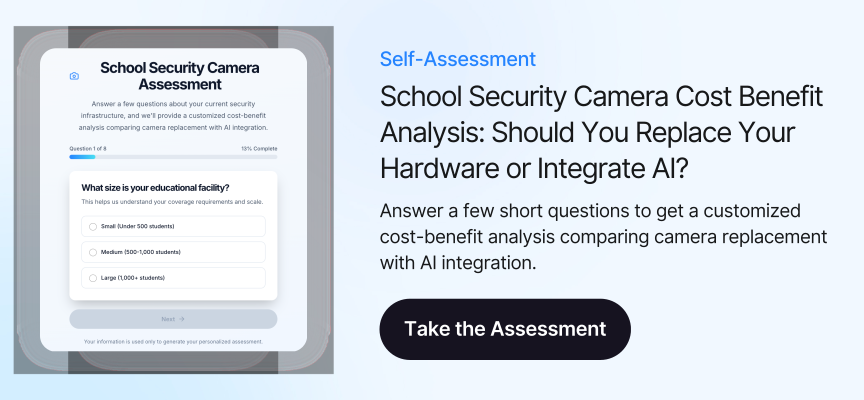
Use this self-assessment to understand your own university’s camera coverage.
Question 3: Can You Track a Person of Interest Across Your Entire Campus?
When an incident occurs, security teams need immediate answers about suspect location and movement patterns. The ability to track individuals across multiple camera feeds and building transitions can be critical for both response and investigation.
This capability requires more than simply having cameras in multiple locations. Cross-camera continuity must allow your system to follow an individual as they move between different camera views. Building transition visibility should eliminate gaps when someone exits one building and enters another.
Security personnel benefit from 3D spatial awareness that visualizes suspect location within the physical layout of your campus in real time. Historical reconstruction capabilities allow rapid analysis of movement patterns from hours or days before an incident.
Universities that have implemented AI-powered video intelligence report significant improvements in their ability to maintain continuous awareness of persons of interest. These systems can track individuals even when they attempt to evade detection by changing direction or putting items away. The technology enables what one campus security professional described as the ability to follow someone throughout the facility no matter where they go.
Question 4: Do You Have Visibility Into Building Access Patterns?
Physical access control represents a fundamental layer of campus security, yet many institutions operate with significant gaps between their access control systems and their surveillance capabilities. Understanding who enters your buildings, when, and how provides essential context for security operations.
Campus security leaders should evaluate the integration between physical access systems and monitoring capabilities using this assessment framework.
|
Access Control Element |
Assessment Questions |
Security Implications |
|
Card Swipe Systems |
Which buildings require ID verification? During which hours? Are all entries logged and monitored? |
Determines baseline accountability and audit trail |
|
Open Access Areas |
Which building entrances remain unlocked during class hours? How are these areas monitored? |
Identifies vulnerability windows requiring enhanced surveillance |
|
Visitor Management |
How do non-students access academic buildings? Is visitor movement trackable? |
Reveals exposure to external threats |
|
After-Hours Protocols |
Do access requirements change after business hours? How is after-hours activity monitored? |
Addresses periods of reduced staffing and oversight |
|
Emergency Lockdown |
Can doors be secured remotely in crisis situations? How quickly? |
Determines containment capability during active threats |
Many academic buildings, particularly older structures, were designed for open intellectual exchange rather than controlled access. This creates legitimate operational challenges that must be balanced against security requirements. The solution is not necessarily restricting access universally but rather understanding where open access exists and implementing appropriate monitoring for those areas.
Learn more about AI-powered video intelligence.

Question 5: What Happens in Your Security Blind Spots?
Every campus has areas where surveillance coverage is limited or non-existent. Identifying and addressing these blind spots is essential for comprehensive security. The first step is conducting a systematic audit of your coverage gaps.
Older building sections present particular challenges since structures built before modern security standards often lack infrastructure for comprehensive camera coverage. Campus perimeter zones require attention because areas where university property meets public streets or residential neighborhoods create jurisdictional complexity.
Interior corridors connecting classrooms deserve scrutiny, particularly in buildings with complex layouts that create natural hiding spots. Transitional spaces including stairwells, service corridors, and areas between connected buildings often receive less monitoring attention. Loading docks and service entrances represent secondary entry points that may not receive the same security focus as primary entrances.
The goal is not necessarily to eliminate every blind spot. The cost and operational impact of total coverage may not be justified. Rather, the goal is to understand where blind spots exist and implement compensating controls. These might include enhanced lighting, additional patrols, or intelligent monitoring of adjacent areas that might indicate activity in unmonitored zones. When you know where you cannot see, you can position your resources to compensate.
Question 6: Are Your Detection Capabilities Keeping Pace With Threats?
Campus security needs extend far beyond weapon detection. A comprehensive approach addresses the full spectrum of safety concerns that affect student wellbeing. University security professionals increasingly recognize that most daily safety incidents involve situations other than weapons.
Fight detection, medical emergency response, and unauthorized access monitoring address concerns that affect campus life far more frequently than active shooter scenarios.
VOLT detects handguns, long guns, and knives that are visible to the camera. Behavioral analysis should detect aggressive behavior, fighting, or crowd formations that might indicate developing conflicts.
Medical emergency recognition will alert you if someone collapses or appears to be in medical distress. Unauthorized access detection can identify individuals in restricted areas or during unauthorized times. Loitering and surveillance behavior detection can identify potential pre-attack reconnaissance, such as someone repeatedly observing the same location.
Learn more about preventing school shootings.
Question 7: Does Your Technology Actually Support Your Officers?
The best security technology is technology that makes your team more effective. Systems that generate excessive false alarms, require constant attention, or fail to integrate with existing workflows can actually diminish security by overwhelming personnel. Before evaluating new capabilities, honestly assess whether your current technology helps or hinders your team.
Signal-to-noise ratio matters enormously. Do alerts represent genuine concerns that warrant attention, or do officers routinely dismiss notifications? Integration capability determines whether new technology works with your existing camera infrastructure or requires wholesale replacement.
Deployment complexity affects how quickly new capabilities can be implemented and what IT resources are required. Training requirements influence whether officers can effectively use the system without extensive specialized training. Mobile accessibility determines whether personnel can receive alerts and view footage from anywhere on campus.
At the University of Illinois Chicago, the campus police force implemented AI-powered video intelligence across 142 critical camera streams of their 3,500 total cameras. The Technical Intelligence Officer reported that the system allows his team to catch and respond to events in real time rather than investigating incidents after the fact. He described the technology as taking security to a level far above what any other tool on the market provides.
Moving from Assessment to Action
Conducting an honest security assessment is the essential first step. The questions outlined above provide a framework for identifying gaps and prioritizing improvements. The answers you discover will be unique to your campus, your resources, and your operational context.
Campus security leaders who want to learn more about how universities are addressing these challenges can explore resources specifically designed for higher education security professionals. These resources include candid conversations with campus and law enforcement leaders who have navigated similar assessments at their own institutions. They discuss implementation realities, budget considerations, and lessons learned from their experiences.
For police chiefs specifically interested in weapon detection capabilities, the School Shooting Prevention Technology Resource Center provides educational content about available approaches and implementation considerations.
Creating Environments Where Learning Can Flourish
The ultimate goal of campus security extends beyond preventing worst-case scenarios. It encompasses creating environments where students, faculty, and staff can focus on education without the weight of safety concerns on their shoulders.
When security leaders at Prescott High School described what changed after implementing proactive detection capabilities, they noted that for the first time, they could get ahead of situations rather than constantly reacting. That shift from reactive to proactive security represents a fundamental change in how institutions can approach campus safety. One administrator described it as being able to intervene before situations escalate rather than always investigating after the fact.
Every campus faces unique challenges based on physical layout, community integration, and operational requirements. The questions that matter most are the ones that help you understand your specific vulnerabilities and the solutions that address them.
Because in campus security, the goal is not just documentation. It is protection.