

Some security professionals wait for incidents to happen before they act. David Wrzesinski refused to be one of them.
As Safety Director at Robinson Independent School District in Waco, Texas, David faced a challenge that echoes across school districts nationwide: a robust camera system covering both interior and exterior areas of multiple campuses, but no one actually watching those feeds in real-time.
The cameras were there. The coverage was comprehensive. But like most schools, Robinson ISD's security infrastructure primarily served as an investigative tool after incidents occurred rather than a prevention system that could stop them from happening in the first place.
That reactive approach didn't sit right with David. So he set out to change it.
The Problem With "Good Enough" Security
Before implementing VOLT AI, Robinson ISD had invested significantly in their camera infrastructure. They had coverage. They had footage. What they didn't have was awareness.
It's a gap that exists in schools nationwide, comprehensive camera coverage without continuous monitoring capabilities. Potential incidents could unfold undetected until after they escalated. Whether involving weapons, fights, unauthorized access, or medical emergencies, the reactive nature of traditional security meant valuable response time was lost while situations developed.
David understood that cameras without intelligence are just recording devices. They document problems. They don't prevent them.
"We weren't monitoring everything before," is how many security professionals describe their pre-AI reality. The math simply doesn't work: you can't ask a small security team to watch hundreds of camera feeds simultaneously. Human attention has limits. Fatigue sets in. Things get missed.
David needed a solution that could transform his existing camera infrastructure into an intelligent, proactive security system: one that could detect threats in real-time and alert staff immediately, enabling swift intervention before situations escalated.
Building The Grid
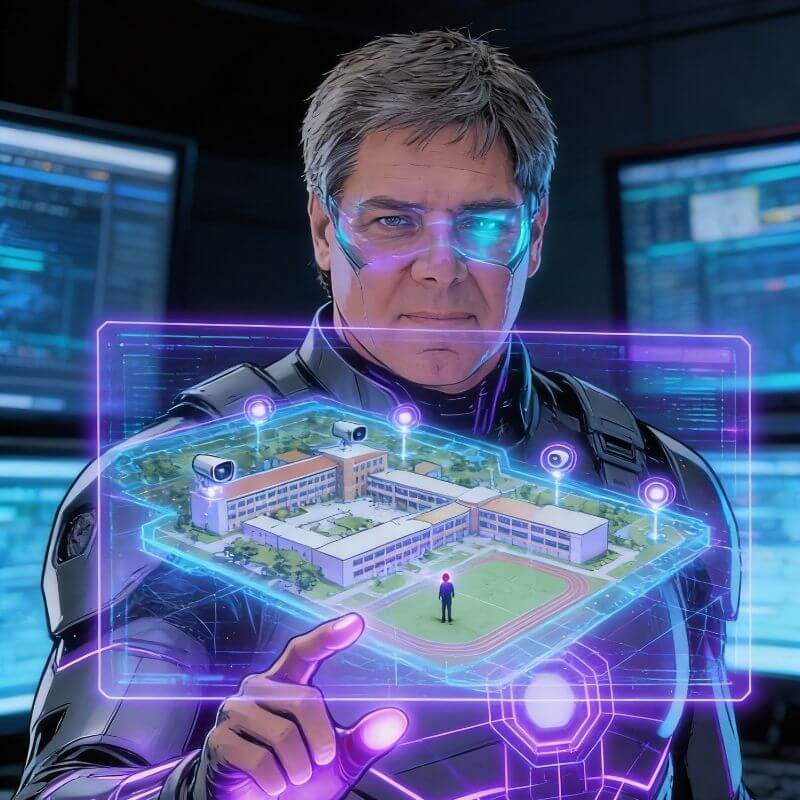
Today, every camera in Robinson ISD feeds into what we've come to call David's "grid." Every movement tracked. Every corner of every campus mapped and monitored. When VOLT AI detects a potential threat, David knows exactly where it is — down to the specific camera, visualized on a 3D map of the facility that allows his team to pinpoint locations and dispatch response in seconds.
The implementation process proved remarkably efficient. David and his team went from initial conversations to a live, functioning system in less than two weeks.
"It was literally 2 or 3 meetings and we got maps to them and got things that they needed and we were testing," David explained.
No rip-and-replace of existing cameras. No massive infrastructure overhaul. No months-long implementation timeline that left the district vulnerable during the transition. VOLT AI connected to Robinson ISD's established camera network and immediately began transforming passive surveillance into active protection.
Phantom Tracking: The Power to Follow What Hides
Here's what makes David's approach truly different from traditional security systems: the tracking doesn't stop when the threat tries to hide.
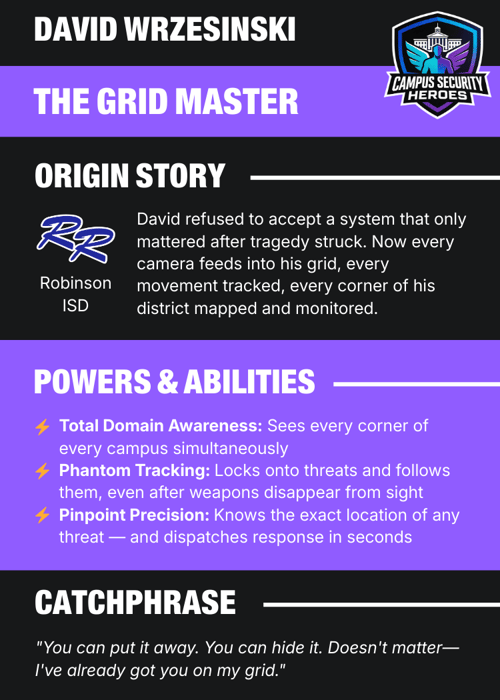
"You can put it away. You can hide it. Doesn't matter — I've already got you on my grid."
That's not just a catchphrase. It's how VOLT AI's continuous tracking works in practice. Once the system identifies a person of interest — someone brandishing a weapon, for example — it maintains visibility on that individual even after the weapon disappears from sight. The person is followed through the facility as they move from camera to camera, giving security teams the situational awareness they need to respond effectively.
Think about what that means in a real-world scenario. A traditional system might detect a weapon, send an alert, and then... nothing. If the person conceals the weapon and walks away, they've essentially vanished. Security has to start from scratch, reviewing footage, trying to figure out where the individual went.
With David's grid, that individual never disappears. The system maintains continuous tracking, providing real-time location intelligence that enables a coordinated response. Security knows exactly where the person is, where they're heading, and can position themselves accordingly.
"After it picks it up, you can put it away and it tracks you all throughout your system," David explained. "It tells you exactly which camera it came from. It has a 3D map that shows where it's at, and so we can pinpoint it really, really quickly."
Proven Through Rigorous Testing
David didn't take VOLT AI's capabilities on faith. He tested them — rigorously, with local law enforcement, pushing the system to see what it could actually do in real-world conditions.
The results validated his decision. Through extensive testing, the system demonstrated its ability to identify various threat types: firearms, large knives, machetes, and even theater props. Crucially, the system proved sophisticated enough to distinguish between genuine threats and legitimate items based on context, avoiding the false alarm fatigue that plagues many security solutions.
The combination of real-time detection, human verification through VOLT's Security Operations Center, and precise location mapping enables rapid response from Robinson ISD's armed security officers. Every alert is reviewed by trained professionals before being sent to campus personnel, ensuring that when David's team gets a notification, it's something that actually requires their attention.
Get answers directly from K-12 Schools who have implemented VOLT.
Beyond Weapons: Complete Campus Awareness
While weapon detection was the primary capability that drew David to VOLT AI, he quickly discovered the system's value extends far beyond identifying firearms.
Robinson ISD now uses VOLT AI to detect:
- Fights and altercations: The system can identify physical confrontations as they begin, allowing staff to intervene before situations escalate. Even more valuable: it can detect gathering crowds, the kind of crowd formation that often precedes a fight. David can dispatch administrators to an area and potentially prevent an altercation from happening at all.
- Medical emergencies: Person-down detection identifies when someone has fallen and may need assistance, enabling rapid response that could prove critical in a medical emergency.
- Unauthorized access: Custom rules allow the team to detect unwanted access during specific times or at specific locations, helping prevent theft and other security concerns.
This multi-layered detection capability means David's grid isn't just watching for worst-case scenarios. It's providing comprehensive situational awareness across his entire district, catching the daily incidents that impact student safety just as effectively as it would catch a major threat.
The Shift From Reactive to Proactive
The impact of VOLT AI at Robinson ISD has been transformative in ways that go beyond specific incident detection. It's fundamentally changed how David and his team approach their work.
Before, security was primarily about investigation. Something happened, and you'd go back through the footage trying to piece together what occurred. Hours of reviewing video. Interviews with witnesses who saw different things. A reactive process that started only after the damage was done.
Now, David operates proactively. His team responds to situations as they develop rather than investigating them after the fact. They can intervene before fights escalate, before unauthorized individuals gain access to sensitive areas, before a medical emergency goes unnoticed in an empty hallway.
"It can detect a group of kids that are gathering in an area and you could dispatch principals to that area and you could avoid a fight, which might end up turning into something else," David explained.
That's the real power of the grid: not just seeing threats, but seeing developing situations and having the time to prevent them from becoming threats at all.
David's Advice for Other School Safety Leaders
Having successfully implemented VOLT AI across Robinson ISD, David has become an advocate for other school districts considering similar technology. His advice is straightforward: don't take capabilities on paper at face value.
Test the system. Push its limits. See what it can actually do in your environment, with your cameras, facing your specific challenges.
"Don't judge it. Test the system... run it through, see how far the concepts there," David recommends.
He also emphasizes the importance of multi-stakeholder buy-in. School boards and administrators need to understand that effective security technology isn't a luxury, it's a necessity. When David demonstrated VOLT AI's capabilities to his board, they were "mesmerized with the presentation" and "couldn't adopt it fast enough."
The ROI conversation matters too. David thinks of VOLT AI as "several different additional safety team members... people that don't ask for vacations and work every day, 365 days a year." When you frame it that way, comparing the cost of technology to the cost of equivalent human coverage, the value proposition becomes clear.
Why We're Celebrating David
The Campus Security Heroes series recognizes the real people doing extraordinary work to protect students and staff. These aren't fictional characters—they're security professionals, administrators, and safety leaders who are transforming how their institutions approach protection.
David Wrzesinski didn't accept the status quo. He saw a gap between having cameras and actually using them for proactive protection, and he closed it. He tested solutions rigorously, built buy-in across his organization, and implemented a system that fundamentally changed how Robinson ISD protects its students.
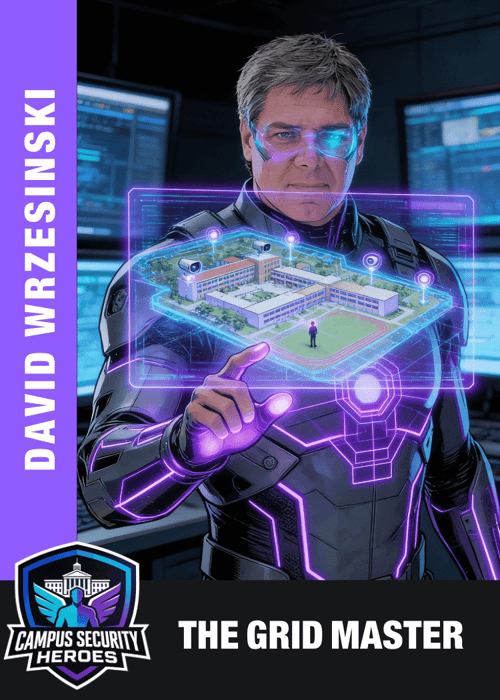
His "superpowers" — Total Domain Awareness, Phantom Tracking, Pinpoint Precision — aren't comic book fantasy. They're real capabilities enabled by AI-powered security technology, applied by a safety professional who refused to settle for reactive security.
Today, every corner of every Robinson ISD campus is monitored. Every threat is tracked, even when it tries to hide. Every response is coordinated through real-time location intelligence.
Because when it comes to protecting students, "good enough" isn't good enough. David Wrzesinski knows that. And now, so does everyone on his grid.
