Insights


Every campus has protectors. Security teams guard buildings. Facilities managers watch infrastructure. Health services care for students. IT secures networks. Each department excels at protecting its piece of the puzzle.
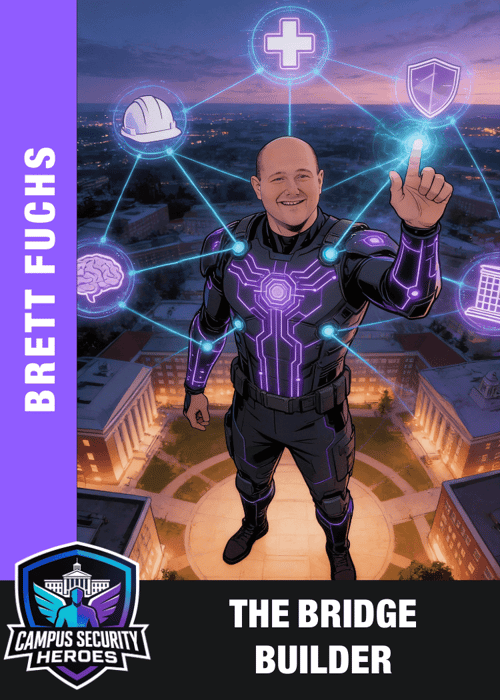
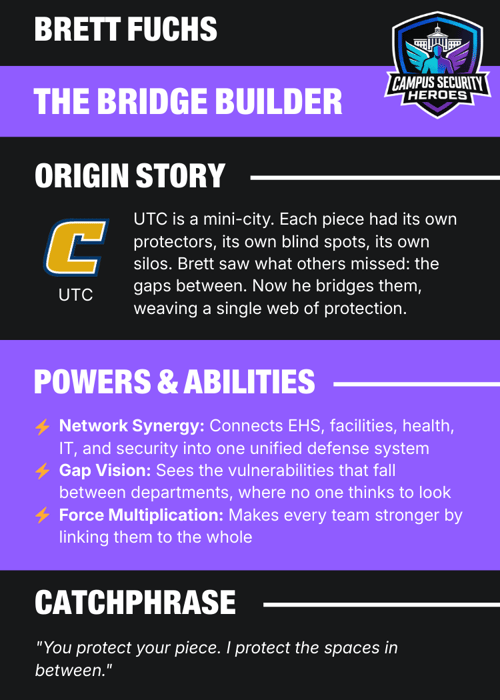
Brett Fuchs protects the spaces in between.
As Director of Emergency Management at the University of Tennessee at Chattanooga, Fuchs brings over a decade of experience in higher education emergency management and behavioral threat assessment.
His role spans emergency planning, threat assessment, communications, and serving as Public Information Officer. But his real superpower is seeing what others miss: the vulnerabilities that fall between departments, where no one thinks to look.
The Mini-City Problem
UTC operates like a small city. Academic buildings. Residential halls. Auxiliary facilities. An off-campus observatory. Parking decks. A power plant running 24/7. More than 12,000 students move through this ecosystem daily, each space with its own rhythms, its own risks, its own blind spots.
Traditional security approaches treated each piece separately. Public safety handled their domain. Facilities managed theirs. Environmental health and safety covered their territory. The result was a patchwork of protection with gaps between every seam.
Fuchs saw the problem clearly. A fall in a parking garage might be a security issue, a facilities issue, a health issue, or an insurance issue. Depending on who you asked, it might be everyone's responsibility or no one's. These ambiguous spaces created real vulnerabilities.
"We needed a tool that could support proactive emergency management, not just after-the-fact video review," Fuchs explains. "We were dealing with everything from falls and fires to loitering and suicide risk. This wasn't just a policing issue. It was an institutional risk issue."
Building Bridges Across Silos
Fuchs approached UTC's security challenges differently than most emergency management directors. Instead of reinforcing departmental boundaries, he worked to dissolve them. His strategy connected EHS, facilities, health services, IT, disability services, risk management, and public safety into a unified defense system.
The key was finding technology that could serve multiple stakeholders simultaneously. When evaluating AI-powered security solutions, Fuchs prioritized cross-functional value. A single platform needed to help security respond to threats, help facilities identify maintenance issues, help disability services ensure ADA compliance, and help risk management document incidents for insurance purposes.
VOLT AI fit that vision. The system integrated with existing camera infrastructure, requiring no major hardware replacements, and immediately began serving use cases across departments that had never shared tools before.
"Emergency management is about prevention, foresight, and protecting people before the moment of crisis," Fuchs notes. "VOLT gives us that edge on every part of campus."
Gap Vision in Action
The real-world applications of Fuchs's approach reveal just how many vulnerabilities exist in the spaces between departments.
- ADA Accessibility Monitoring: A camera at the only ADA-compliant entrance to the library alerts if someone waits too long, flagging possible elevator failures or individuals needing assistance. This serves both disability services and facilities management simultaneously.
- Suicide Prevention: VOLT monitors top levels of parking garages and pedestrian pathways for individuals climbing railings or loitering in concerning patterns. "If someone's up there, we want to know before a bystander calls it in," Fuchs explains. This proactive approach gives responders critical lead time for intervention.
- Trip and Fall Detection: The system has flagged multiple incidents involving staff and visitors. These alerts preserved crucial footage that would have otherwise been overwritten, supporting both insurance reviews and EHS investigations. One detection system now serves legal, safety, and risk management needs.
- Child Safety at Events: UTC hosts many public events on campus. VOLT's ability to track individuals backward through time proves critical for locating missing children or understanding incident origins. Event management and public safety now share the same visibility.
- Lone Worker Protection: UTC's power plant operates 24/7 with workers who may be alone for extended periods. VOLT is configured to alert if no person is detected during scheduled check-ins, ensuring immediate awareness if a staff member becomes incapacitated. Facilities and safety now share responsibility for these vulnerable workers.
Force Multiplication
Fuchs describes his approach as force multiplication. Every department becomes stronger when linked to the whole. Security gains visibility into facilities issues. Facilities gains awareness of safety incidents. Health services gains early warning of student crises. Risk management gains documentation across all domains.
The numbers tell part of the story. Faster claim verification. Smarter camera placement. Better coverage evaluations. Proactive oversight instead of reactive investigation.
But the deeper impact is cultural. Departments that once operated in isolation now collaborate on shared challenges. A fall in a parking garage triggers coordinated response from security, facilities, and health services. A struggling student receives support from multiple directions simultaneously.
"You protect your piece. I protect the spaces in between," Fuchs says. It's become his operating philosophy.

Get answers directly from Colleges & Universities who have implemented VOLT.
Driving Organizational Change
Fuchs's success at UTC demonstrates how emergency management can reshape institutional thinking about risk. By showcasing cross-functional value, he's helping the university move beyond siloed protection toward integrated resilience.
The approach is spreading. EHS now works more closely with insurance on claim verification and incident documentation. Facilities and planning use security insights for smarter camera placement and coverage evaluations. Mental health and student support teams have new tools for behavioral risk detection. Access control and IT collaborate on physical security redesigns.
Each connection strengthens the whole. Each bridge Fuchs builds closes another gap where vulnerabilities once hid.
The Bridge Builder's Legacy
Campus safety professionals often focus on protecting specific territories. Buildings. Networks. People. Equipment. Brett Fuchs recognized that the most dangerous vulnerabilities exist in the spaces no one claims.
His gift is seeing those gaps and building bridges across them. EHS connects to facilities. Security connects to health services. IT connects to risk management. Student support connects to public safety. The result is a web of protection that covers the entire campus, including the spaces between.
For Fuchs, emergency management isn't about responding to crises. It's about preventing them through foresight, integration, and relentless attention to the vulnerabilities that fall between everyone's piece.
He protects the spaces in between. And that makes everyone's piece safer.