Insights
12-Year-Old Arrested in Volusia County Shooting Plot

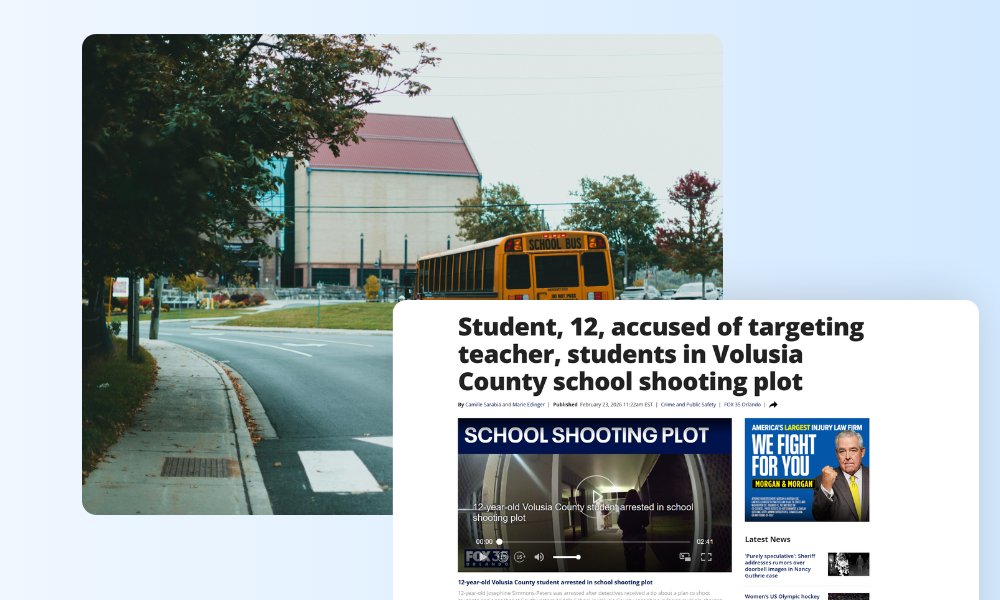
- A 12-year-old Volusia County student was arrested after posting a detailed school shooting plan online that named a specific teacher and fellow students as targets.
- Investigators identified Josephine Simmons-Peters through IP tracing after an anonymous tip led them to a since-deleted post on a public website.
- The student ultimately admitted to writing and publishing the plan, which included a timeline, a meeting point, and targets connected to personal grievances.
- The case highlights a critical gap in school safety: most threat detection still depends on human tips rather than automated systems capable of monitoring digital threats in real time.
A 12-year-old Volusia County student was arrested after allegedly posting a detailed school shooting plan naming specific students and a teacher as targets at Southwestern Middle School in DeLand, Florida.
The case highlights the critical role of anonymous tip systems, digital threat monitoring, and rapid investigative response in preventing school violence before it occurs.
The student, Josephine Simmons-Peters, faces multiple charges, including written threats to kill and misuse of a two-way communication device.
This incident underscores the urgent need for AI-powered threat detection systems that can identify and flag online threats in real time — before they become tragedies.
Volusia County Incident Details
A 12-year-old student at Southwestern Middle School in DeLand, Florida, was taken into custody in the early morning hours of February 23 after investigators said she posted a detailed shooting plan online targeting a teacher and fellow students, according to the Volusia County Sheriff's Office.
As reported by Camille Sarabia and Marie Edinger for FOX 35 Orlando, the Volusia County Sheriff's Office received an anonymous tip on February 22 from a concerned individual who had learned of the plan through a friend. Although the original post had been removed from the website where it was published, investigators traced the remaining comments and username to an IP address in DeLand, ultimately identifying Josephine Simmons-Peters as the suspect.
The plan was disturbingly detailed — outlining when to arrive at school, where to meet an accomplice, and when and where to begin the attack. The document named a specific teacher whom the student claimed had given her a failing grade, as well as individual students by name. Investigators corroborated the targets by speaking directly with the teacher, who confirmed Josephine was among students who had received a failing grade, and with a named student who recalled a classmate named "Josie" from his math class.
A boy identified in the plan as a potential accomplice also confirmed to investigators that Josephine had created the shooting plan. When detectives spoke with Josephine herself, she initially denied involvement before ultimately admitting to writing and posting the plan online.
Deputies arrested Josephine around 1:30 a.m. on February 23. She was transported to the Volusia Family Resource Center and faces charges of written threats to kill and misuse of a two-way communication device.
Why Digital Threat Detection and Monitoring Matter for School Safety
The Volusia County case is a sobering reminder that today's school threats often originate online — on websites, messaging platforms, and social channels — long before they manifest on school grounds. In this instance, the threat was only discovered because a concerned peer reported it. Had no one come forward, the detailed plan may have gone undetected entirely.
This is precisely the gap that AI-powered threat detection is designed to close. Automated systems capable of monitoring open and semi-public digital environments can flag threatening language, violent ideation, and target-specific content in real time — enabling school administrators, law enforcement, and safety personnel to act before a plan moves toward execution.
The speed of the Volusia County investigation — from tip to arrest in under 24 hours — demonstrates what's possible when humans and technology work in concert. AI-assisted monitoring can serve as a first layer of detection, surfacing threats even when no tip is ever given.
Lessons from the Volusia County Case
Security leaders and school administrators can draw several important takeaways from this incident:
Online Threats Precede Physical Ones: In this case, the threat existed in digital form well before any physical action was taken. AI-powered content monitoring tools can detect threatening language and alert the appropriate personnel before a plan progresses.
Anonymous Tip Systems Save Lives: The intervention here began with a concerned peer. Schools and districts should pair robust anonymous reporting tools with AI systems capable of independently identifying threats to create redundant layers of protection.
Specific Targets Demand Immediate Response: The level of detail in this plan — named victims, a timeline, a meeting point — signals high-risk intent. AI threat assessment tools trained to recognize target-specific language can help prioritize and escalate alerts appropriately.
Age Is Not a Safety Variable: This incident involved a 12-year-old student. Effective threat detection systems must be calibrated to recognize warning signs regardless of the perceived profile of the individual behind the threat.
Speed of Identification Is Critical: From tip to arrest took less than 24 hours in this case. AI monitoring tools that surface threats in real time can compress that window even further—or eliminate the need for a human tip altogether.
The Volusia County arrest will likely prompt school districts across Florida and the broader country to assess whether their current digital monitoring and threat assessment capabilities are sufficient to catch threats that originate and circulate online.
VOLT's AI-powered security solutions help institutions implement intelligent threat detection systems that enhance safety while preserving positive environments.
Concerned about your school's threat detection capabilities? Learn how AI-powered systems identify and flag threats in real time at our AI Security Camera Resource Center.
Editorial Disclosure: This article was produced with AI assistance and reviewed by the VOLT AI editorial team. News sources are linked for verification. VOLT AI provides AI-powered security solutions for educational institutions, healthcare facilities, and residential communities. For more information, visit volt.ai.