Insights
Secure Vestibules in Schools: Planning the Front Office Around the New Entrance
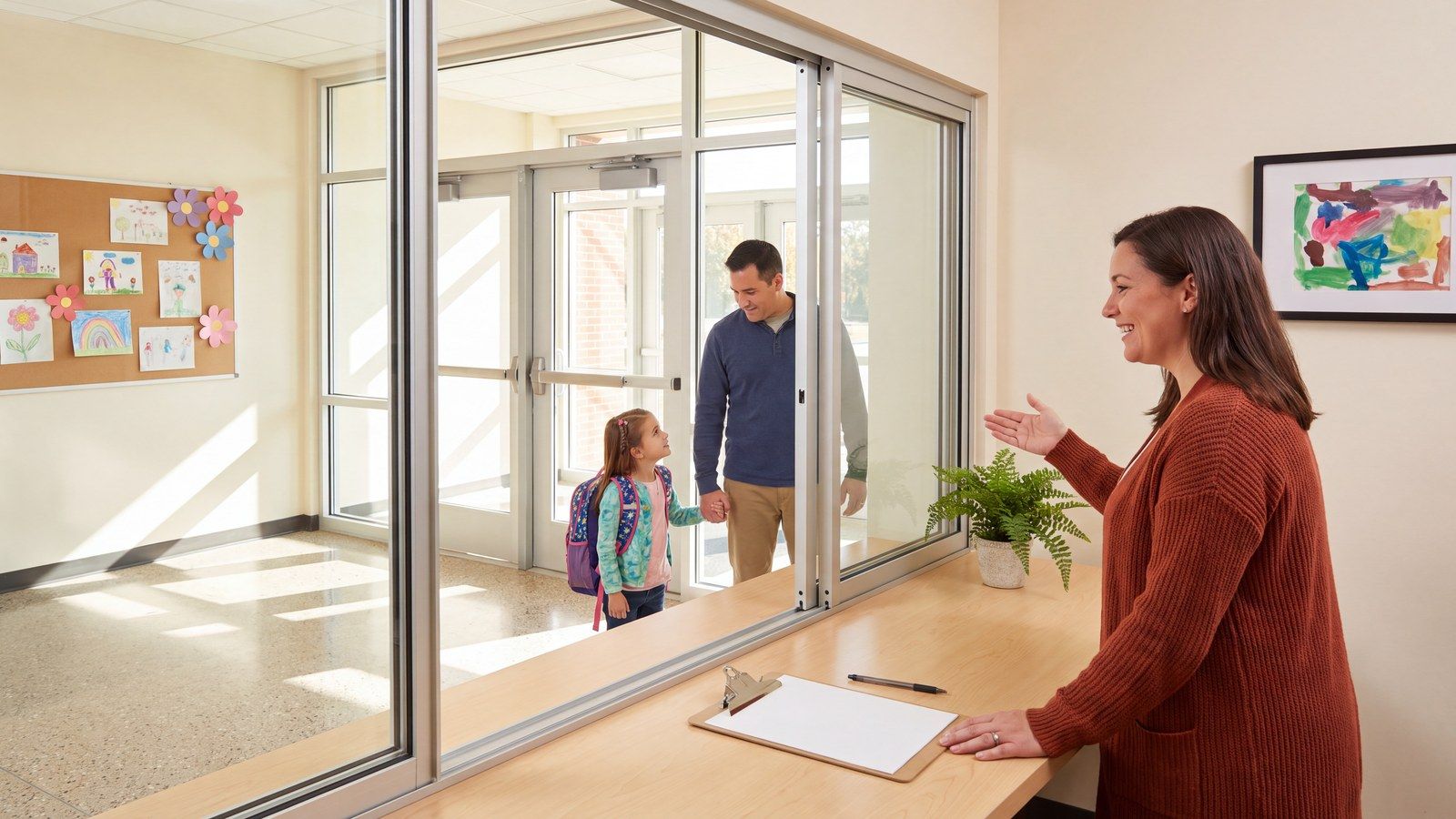
A secure vestibule decides who gets past the front door, but a calm school day still depends on the front office noticing what happens once a visitor, a late student or a parent picking up early is inside.
What one school committee was asked to approve
On June 2, 2025, the Director of Business & Finance for Chelmsford Public Schools in Massachusetts sent the School Committee a memo for its June 3 meeting summarizing the procurement for secure school entryways. The memo says the FY2026 capital budget has an approved project to construct five secure school entryways, at Byam, Center, Harrington, South Row and Parker. The work covers new secure entry vestibules, with existing storefronts modified or replaced, and the suggested motion asked the committee to award the construction contract for the four elementary schools and Parker Middle School in the amount of $269,750.
That is a common buyer concern in plain public record: the district had already decided the front door needs a controlled stop between the sidewalk and the hallway, and it set capital money aside to build one.
What a vestibule changes, and what it doesn't
A vestibule gives the office a pause point. A visitor waits in a small room, talks through a window, signs in and is buzzed through. That handles the moment at the door. The rest of the front of the building is still ordinary traffic:
- Morning arrival. Inner doors may stay open for a few minutes while buses unload and families walk younger students in.
- Late arrivals and early pickups. One at a time, all day, each one a short conversation at the window.
- Deliveries and contractors. They are let in for one stop and then need to get somewhere else in the building.
- Dismissal. Parents, staff and students cross the lobby in both directions at once.
The moments that matter here are the ones a busy office can miss: a crowd forming in the lobby at dismissal, a visitor who was buzzed in for the office and then walks down the classroom hallway instead, or a package that disappears from the front counter while the window is busy.
Questions to settle before the walls go up
- Who staffs the sign-in window during arrival, lunch and dismissal, and who covers it when that person steps away?
- From the office desk, can staff see the vestibule, the inner door and the start of the main hallway, or does the new layout block that view?
- After sign-in, does an adult walk the visitor to where they're going, or do visitors go on their own?
- When are the inner doors open on a schedule, and who confirms they close afterward?
- Which camera views cover the vestibule and the lobby, who looks at them during the day, and how long is that footage kept under the district's existing policy?
Construction is the easy part to schedule. These answers decide whether the new entrance works on an ordinary Tuesday in February.
Where VOLT fits
VOLT is built to notice moments that matter: visible weapons, crowds forming, theft, and vandalism. At the front of a school, that could be a crowd forming in the lobby at dismissal, an item taken from the front counter, or damage to the new vestibule glass after hours. VOLT shows where a flagged moment is happening on a 3D floor plan, so responders know where to go. Weapon detection runs on the same cameras: VOLT detects handguns, long guns, and knives that are visible to the camera. VOLT is built to run on the cameras you already have. Each alert is reviewed by a person by default before your team is notified.
Keep the front door ordinary
A new vestibule is a real step, and the office staff who work beside it are still what makes it work. When the staffing, the sightlines and the camera views are planned together, the front door can stay welcoming for families while the office keeps a clear picture of the lobby.
If your district is planning entrance work for the next school year, you can request a demo at https://volt.ai.
Helping schools and campuses look out for the moments that matter.